I've dealt with this issue before, and the recent talks between China and India over their borders are turning out to be a joke. Apparently, India has made a grand 'concession' that Tibet is really a part of China, which settles everything. Except that China defines "Tibet" quite differently than India does. A part of (what everyone else recognises as) India is obstinately referred to as "South Tibet".
From Eurasia Review:
February 10, 2012
By Bhaskar Roy
There have been projections among some Indian experts and think tanks that a limited Chinese attack along the unresolved Sino-Indian border may be imminent. This view cannot be totally faulted. They are based on China’s aggressive official and semi-official postures and warning to India, especially on the sovereignty of Tawang, an important Buddhist pilgrim town in India’s north-east state of Arunachal Pradesh.
China claims officially the whole of Arunachal Pradesh as its territory. The official Chinese media, have started referring to Arunachal Pradesh as South Tibet. This is a very important shift in China’s nomenclature of Arunachal Pradesh. This is an effort to now make this Indian state a historical part of Tibet which China militarily occupied in 1950. With India among other countries in the world having acknowledged the original Tibet as a sovereign part of China, extension of Tibet to Arunachal Pradesh may give China an opening into its sovereignty claim on Arunachal Pradesh. Beijing believes it as another instrument to pressure India.
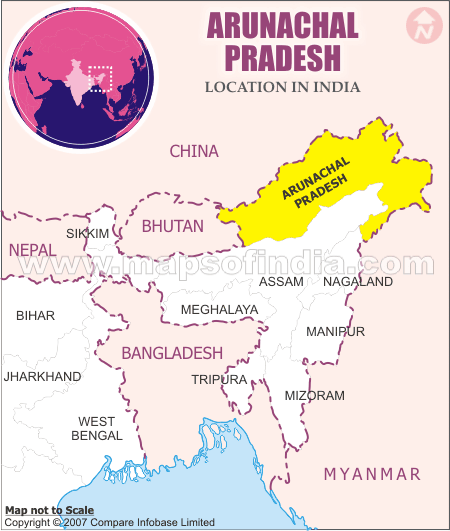
It is now common knowledge that China continues to support insurgent and separatist groups in north-east India. If Tawang went to China it could garrison its troops there, ignite a major turbulence in north-east India, and roll down from Tawang to engage or cut off the Siliguri chicken-neck, preventing or slowing down Indian military movement. A success of this strategy would be disastrous for India. One can, therefore, understand China’s strong objection and criticism against India’s enhanced force deployment in north-east India.
What is particularly galling for Indian observers is the fact that China is quietly building its military deployment in Tibet or Tibet Autonomous Region (TAR) that does not appear normal. The Chinese military has constructed or upgraded five airfields in close proximity of the border from the western sector to the eastern sector. There are indications that round the year air deployment is taking place or has already taken place. In the height of winter in January this year, People’s Liberation Army Air Force (PLAF) conducted live fire exercises in TAR.
The railway net work in Tibet may be projected by the Chinese as for development purposes, but its military and strategic emphasis are obvious. At least one full train load of transfer of arms and ammunitions from Golmud to Lhasa has already been conducted. The next step is bring one line to Xigaze (Shigatse) near the eastern sector border, and another to the Nepal border and then on to Kathmandu.
The road infrastructure along the border on the Tibetan side is being continually upgraded, and high altitude military exercises have also been conducted. In fact, two-dimensional military preparations in TAR can be said to be in an advanced stage.
And the Chinese public is being indoctrinated with the case for war with India:
As is well known, the Chinese Communist Party and the government have kept their people starved of information on the happenings in the world. The people have been fed by the state and party controlled media, tailored to project official views and thinking. China’s 500 million netizens’ views on different countries are shaped by official media. A study made by Simon Shen, Associate Professor in the department of social sciences, Hong Kong Institute of Education (published, China Quarterly, Sept. 2001) reveals interesting insights into the minds of these netizens. One thing that emerged from Simon Shen’s three-year research was that 90 percent were hostile to India. On territorial issues, the result was “why should China negotiate with India when it is superior and can hold off India?” India is also seen as servile to the west, and also as imperialist. Over all, the views are anti-India and based very closely if not exactly to the Chinese official propaganda.
This deliberately created mind set by the Chinese authorities can be a double edged sword. While it creates support for the party and the government, at times this can also pressure the authorities to do what they may not want to do. The Sino-India border issue is one of the questions discussed by the Chinese netizens who prefer a military strike in “South Tibet”’ Arunachal Pradesh, to teach India a lesson. These views are not of the 1950s or 1960s, they are contemporary and relevant.
But we have established agreements between the two countries about the border, and China has to honour those agreements, right? Nope:
An India-China conflict can manly be visualized along the borders. This issue is just not moving forward, and China does not want to under the current bilateral agreements. The issue is that China signed an agreement at the Prime Ministerial level in 2005 that there will be no exchange of settled population areas. Since then, they have reneged on this. The recent (Jan 16-17) Senior Representative (SR) level talks on the border and other issues not only saw little progress but rather froze such meetings for some time to come. Hence, one can safely believe that the boundary talks have gone to the mode of ‘time buying’.
So Chinese citizens are ready to go to war with India, China is building the infrastructure needed to go to war in that area, and China claims an entire province as part of India.


Also, from The Daily Mail:
India has increased its troop strength in the region and has taken several measures to improve infrastructure, including border roads.
Beijing has never acknowledged the McMohan Line separating Arunachal from Tibet as the official boundary with India. New Delhi has rejected China's claims over the state.
Sounds like it's all "settled", doesn't it?


No comments:
Post a Comment