Showing posts with label border tensions. Show all posts

Saturday, March 17, 2012

Bhutan military effort in Assam shows some success

Bordering Assam, with various rebel camps of Maoist guerilla groups and separatists, Bhutan has had its hands full trying to restore security. These armed groups frequently crossed over to Bhutanese territory and established camps to avoid Indian military operations, and they are not welcome visitors. Many of these armed groups are funded, armed, and vocally supported by China in an attempt to create an insurrectionist internal front in case of a border war with India. Obviously, Bhutan faces the same threat from China, and clearing out these armed groups is in their national and security interests.

KOLKATA: Almost 10 years after joint operations along the Indo-Bhutanese border to flush out militant groups from the northeast taking shelter in the Himalayan kingdom, Bhutan is feeling confident enough again to increase its exchanges with Assam in education, health and business, Bhutan government sources said on Monday. With the improvement in the security scenario in Assam, "the confidence level has gone up," they added.
Last week, Bhutan government officials met Assam authorities in Dispur and discussed the possibility of sending students from Bhutan to medical and engineering colleges in Assam under the "foreign students quota." Initially, the possibility of sending two students to Guwahati Medical College and two to any of the government engineering colleges was discussed. Later, Bhutan could send students also to private engineering colleges in the state. But Bhutan would still like its students to be placed in places like Guwahati and Silchar, and not in upper Assam towns like Dibrugarh where the anti-talks faction of Ulfa was active.
Since the launch of "Operation Flushout" in December, 2003, in which the Royal Bhutan Army had taken a leading role in dismantling camps of Ulfa, NDFB and KLO in Bhutan, a sense of uncertainty had prevailed on the Assam-Bhutan border for fear of retaliation. Under advice of Indian authorities, all vehicles with Bhutanese registration number plates used to be escorted by Indian security force vehicles on the Indian side of the border. "Not 10, but for 20 years we did not send Bhutanese students for studying in Assam for security reasons," said a source.
Not only students, but Bhutanese nationals along the border needing medical care are now safer in crossing into Assam.

Beyond these simple exchanges, Bhutan needed to forcefully respond to the danger these Maoist groups posed after the bombings along the border last May.
KOKRAJHAR: There was panic in the Bhutanese border towns of Phuentsholing and Gelephu after two IEDs went off, injuring one person, on Sunday night. While the first bomb exploded at Phuensholling at around 10 pm, another one exploded almost two hours later near a cinema at Gelephu.
KOLKATA: Days before Bhutan King's wedding, twin explosions rocked Phuentsholing on Monday evening, a small town bordering Jalpaiguri district of West Bengal. Following the serial blast, state police have alerted cops in all six north Bengal district fearing further sabotage.
Locals at Jaigaon - the Indian town - yards away from Phuentsholing said that around 6 pm, they heard two huge thud within couple of minutes and people started running towards India through Bhutan gate in panic. Bhutan police and Royal Bhutanese Army took control over the explosion site soon after the incident and closed down the border gate for security reasons.
Sources said two improvised explosive devices (IEDs) were planted at the crowded market area of the town, hardly 50 meters from the border gate. "A bomb was hidden in dustbin and another was planted behind flower tubs in front of Hotel Pelzong," sources said. Intelligence officers said that low intensity IEDs were used in the explosion.
Bhutan government is yet to announce the number of the injured, but sources said among dozens of injured one is an Indian citizen. "He is a native of Jaigaon. He went inside Bhutan for some work and sustained shrapnel injuries following the blast", said BL Balia, president of Jaigaon trader's association.
Intelligence officers have reasons to believe that militant groups who are against the Bhutan monarch have planned the explosion before the king's wedding ceremony. Though intelligence officers are yet to confirm the group behind the blasts, they suspect the anti-monarchy Communist Party of Bhutan (Maoist).
Months ago, on May 23, insurgents triggered explosion at Phuentsholing and Gelephu - both border towns in Bhutan. In 2006 and 2008 similar explosion left scores injured at Phuentsholing.
Readers may need to be reminded that Bhutan has been a Constitutional Monarchy for several years now. 
Tiny, tranquil Bhutan is being forced into a war it does not want by the relentless pressure of the Chinese military and their Maoist proxies:
Over the past century Bhutan has not fought any war, and its army has remained little more than the royal bodyguard to Oxford-educated and Scot-style-kilt-wearing King Dorje Synghe Wangchuk. Although the Royal Bhutan Army was trained by India under a treaty signed in 1948 that permits India to help the country in the areas of foreign policy and defense, it has never been baptized in the blood of war. There has never been any need for a joint defense operation by Bhutan and its giant patron, and little need for India's assistance in foreign affairs, barring help for the tiny kingdom to join the United Nations. Bhutan maintained strict neutrality during the India-China War of 1962 and, to the annoyance of many in India, disarmed fleeing Indian army personnel who entered its territory.

But last weekend the long period of peace enjoyed by the Royal Bhutan Army came to an end, as 16 of its personnel sustained mild to critical injuries, against six Indian insurgents killed, while flushing them out of the dense forests astride the arterial road connecting the kingdom with India. The insurgents, under pressure from Indian security forces determined to free the sensitive northeastern part of the country from a growing rebellion that prevents development and affects trade and commerce in the tea-producing areas of Assam state, had made Bhutan their base of operations.

The king informed Indian Prime Minister Atal Bihari Vajpayee of the impending operation on the night before it started and sought logistical support from India's Kolkata-based Eastern Command in the form of night-vision equipment, automatic weapons, mortars and grenades besides bulletproof jackets and jungle-warfare equipment. About 3,000 well-equipped insurgents were hiding in the Dooars foothills of Bhutan with their families, and on the first day the clean-up operation on Sunday, an estimated 50 people, including six mid-level rebel leaders, were seriously injured or believed killed.

As the Indian army sealed the border and the Royal Bhutan Army continued its pressure, however, it appeared that India was far from a solution to the insurgency in the northeast, as some of the senior leaders are believed by intelligence sources to have slipped into Bangladesh or Nepal. Bhutanese sources at the border discount the possibility of the insurgents moving to the high mountains of northern Bhutan on the grounds that it would be difficult for people used to living in the plains of Assam to live in a high-altitude environment. They would also face a food shortage in the sparsely populated northern region.

Three insurgent groups, all from Assam state, are believed to be holed up in Bhutan, where they have been extracting money from the truckers and the small business groups trading on the main road leading to the capital, Thimpu. The largest group belongs to the United Liberation Front of Assam (ULFA); next comes the National Democratic Front of Bodoland, mostly Bodo tribals; and the Kamtapur Liberation Organization. 
Meanwhile, China itself is building roads right up to the border of Bhutan, even making bold incursions into the country with this effort. It's no secret that these roads are for military purposes, nor is it mysterious that the Chinese military is constructing barracks in the disputed territory and moving troops in. Pressed on one side by the Chinese military, and on the other by China's well-armed proxies, Bhutan is in a dangerous situation. India already has its hands full fighting the rebel groups, and can ill afford to defend Bhutan as well.

Thursday, March 01, 2012

India holds military exercises in disputed region

China and India briefly went to war with each other in 1962, but the effort turned out to be much more difficult than anticipated for both sides. The high altitude, barren landscape, and rugged terrain are formidable challenges to a modern military.

Over the past few years, this region has once again heated up. Nothing really has changed since 1962, and both sides seem to have been expecting the other to concede.
 
From The Times of India:
NEW DELHI: India has begun major military exercises close to the Chinese border involving Special Forces of the Army and frontline fighters such as Su-30MKI as part of the endeavour to be battle ready in the inhospitable mountainous region. Code-named as 'Pralay' (devastation), the day-and-night exercises are mainly dominated by the aerial manoeuvres with support by ground forces.

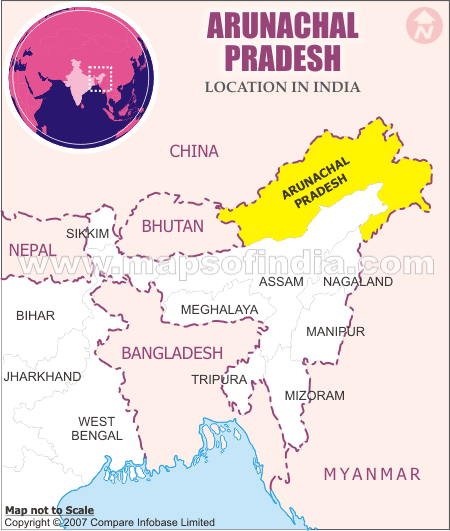
The four-day exercises in the north-eastern sector, including Arunachal Pradesh, began yesterday, coinciding with the official India visit of Chinese Foreign Minister Yang Jeichi here. China has been laying claim over entire Arunachal Pradesh and voices objections whenever any senior union minister visits the state. IAF spokesman said the exercises were taking place "along the Brahmaputra river and eastern region" and "involves joint Army-Air Force operations by Eastern Air Command and Army Eastern Command."

The exercise is aimed at testing the combat potential of the IAF in various roles such as air defence, ground support operations, counter air operations and electronic warfare, he said. Besides the frontline Su-30MKI, Mirage-2000, MiG-29 and Jaguar fighter aircraft, IAF would be flying the strategic lift C-130J transport plane along with AN-32 and the AWACS.
Also, from The Washington Post
A visit by India’s defense minister to a border state claimed by China, accompanied by a fly-past by fighter jets recently stationed in the area, provoked some frosty advice from Beijing not to “complicate” matters. In return, the Indian defense minister, A.K. Antony, called China’s comments “most unfortunate” and “really objectionable.”
The spat, experts say, is a symptom of a deterioration in relations that began in 2005, as India drew closer to the United States and negotiated a civil nuclear cooperation agreement.
That new alignment appeared to threaten Beijing and set relations with India on a downward spiral — so much so that India’s multibillion-dollar military-modernization plans are now largely directed toward containing the growing threat from China.
“Ever since the U.S. nuclear deal in 2005, relations with China have been going through a turbulent time,” said Brahma Chellaney at the Center for Policy Research in New Delhi. “Nothing has changed in recent months to suggest that turbulence is easing or subsiding. What we are seeing actually is that Chinese state media is taking an increasingly hard line.”

Saturday, February 18, 2012

China border troubles continue

China has been making recent public remarks about the state of negotiations with India over the disputed border.
From The Hindu:
A month after India and China held the fifteenth round of border talks, a commentary in a Chinese newspaper has questioned India's claims on Kashmir and asserted that the only dispute was over the status of Arunachal Pradesh.
An article in the Communist Party-run Jiefang Daily, or Liberation Daily newspaper said the disputed western section of the border — including the Aksai Chin region which is now under China's control — was not part of the dispute, underscoring how far apart both countries' positions remained even after 15 rounds of negotiations.
The commentary said: “The Indian side believes that the border dispute between China and India covers not only the eastern region of 90,000 sq km but also the western region of 30,000 sq km and the western region is India's too. This wrong argument, which totally disregards the history, still has supporters in India.
The article, written by an India scholar in the Shanghai Institute of International Studies, Wu Yongnian, was the first Chinese reaction to last month's border talks, and it underscored a hardening in China's position over the western section over recent years, analysts and officials said.
In New Delhi last month, National Security Adviser Shivshankar Menon and Chinese State Councillor Dai Bingguo, the two Special Representatives, discussed a framework for the settlement of disputes in all three sectors — western, middle and eastern. This was in keeping with the 2005 agreement on Political Parameters and Guiding Principles, which marked the ending of the first of three stages of negotiations.
According to Article III of the agreement, the boundary settlement would be “final, covering all sectors of the India-China boundary.”
 China appears to want to split up the various border disputes, and the talks are not going well, despite public shows of optimism.

The Times of India quotes China Daily:
"The first issue is the China-India border negotiation. China and India have held 15 meetings of special representatives for the border issue.
"Although the meetings have made many positive achievements, it is still far away from reaching a fair, just and reasonable agreement," the write up in the opinion page said.
The main barrier still comes from the Indian side as Indian media insist that the border line between China and India should be based on the " McMahon Line" left by British colonists, it said also India believes that the border dispute between the two countries covers not only the eastern region of 90,000 square km but also 30,000 sq km in the western region.
"This wrong argument, which totally disregards the history, still has supporters in India," it said.
Yet another reason that delaying the agreement was India's multi-party political system as well its society which is extremely complicated, it said.
"Various Indian political parties have different understandings on the China-India border issue, and therefore, it is hard for them to reach an agreement on the issue," it said.
It seems obvious that, in a democracy such as India, you are not going to have the consensus of opinion that you find in China.
 China has made 'concessions' with Tajikistan, Kazakhstan, and Kyrgyzstan in border talks previously. But there seems to be a pattern of China making huge (and unreasonable) demands, while settling for far less:
In the 1990s, China began negotiating settlements with these countries. Border agreements with Kyrgyzstan and Kazakhstan were reached in 1996 and 1998 respectively. Border talks with Tajikistan were delayed by the civil war there. However, talks gathered momentum in the late 1990s and an agreement was reached in 2002. It was this agreement that was ratified recently.

Analysts have drawn attention to the territorial concessions that China extended to resolve its many disputes. Of its 23 territorial disputes active since 1949, China offered "substantial compromises" in 17, usually agreeing "to accept less than half of the territory being disputed," M Taylor Fravel, associate professor at the Massachusetts Institute of Technology, pointed out in the article "Regime Insecurity and International Cooperation: Explaining China's Compromises in Territorial Disputes," published in the journal International Security.

However, there is more to it than meets the eye. The territorial concessions that China is believed to have made are not quite as substantial as they appear to be. Srikanth Kondapalli, a China expert at the Jawaharlal Nehru University in New Delhi pointed out that China's strategy of stepping up territorial claims and then settling for less has enabled it to appear to be making a major territorial concession to reach a border resolution agreement. In several disputes, "whether China actually gave up territory or made a substantial concession is a debatable question," he told Asia Times Online.
 Chinese media has built up an anti-Indian sentiment, and the media is completely State-controlled. I outlined some of this in a previous post. Much of it is jingoistic, inclined toward "teaching India a lesson". 

India, for its part, has also stirred up resentments in the media over the border conflict.
The shame of a lost border war left a long tradition of anti-Chinese slant in Indian newspapers, to the point where it doesn’t even seem like an aberration. But for some years now, the tone of a large section of the media has turned decidedly strident, a condition the country’s leading Outlook magazine once diagnosed as "Sinositis". Where once the China reportage gave the impression that for some in the media the war never quite ended, now one gets the sense that the infected are, in fact, itching for another round. Brace yourself for more malignant stuff this year, which marks the 50th anniversary of the war.

Many of the China-bashing stories doing the rounds in Indian papers are a mixture of reflexive phobia, envy, anxiety and great-game bluster, with headlines such as Wary of China moves, India, US & Japan plan talks; As China looms, US tells India to lead Asia; etc. Some are products of the occasional public spats on issues such as territorial rights, and are appropriately combative (Manmohan to Wen: Back off on South China Sea). And, when they are not openly hawkish and baying for blood (With China in mind, India tests new-generation Agni missile with high 'kill efficiency', screams a November headline), they are passive aggressive at the minimum, often betraying a degree of inferiority complex. The subheading to another November story headlined East Asia meet to have China tilt read INDIA STAND: Can't check them, will wait and watch. And that's not even an editorial!

Then there are the Chinese "incursions" stories - the most potent, and the fountainhead, of all Sinoscare media motifs in India. These stories, liberally peppered with alarmist words like "aggression", "transgression", "encroachment", and the like, follow a familiar pattern. "Sources", mostly unnamed, tell a paper or a TV channel how Chinese forces have been intruding into Indian territory; a comparison with similar intrusions in previous years establish how the Chinese menace is rising; followed by accounts of Chinese military build-up.
 The "McMahon line" is the only recognised border, and China has acceded to it in the case of Myanmar (its ally). In the cases of India and Bhutan, however, it is considered unreasonable

The Sino-Indian border dispute arose out of the Chinese occupation of Tibet. China's refusal to grant internal autonomy to Tibet has kept the pot boiling in Tibet and the Chinese view Indian asylum to the Dalai Lama with suspicion. This, despite the fact that India has accepted Tibet as part of China.

The Chinese have kept the border 'unsettled' so as to keep it as a ready excuse to intervene in the affairs of the Indian subcontinent. But there is a larger Chinese design at work here. 

It showed this intent in 1965 though not during the 1971 Indo-Pakistan conflict due to the erstwhile Soviet Union checkmating it on the Amur-Ussuri border.

Initially, the dispute was over the Aksai Chin area and the Chinese strategic road passing through it connecting Sinkiang with Tibet, a military necessity. Its claims over Arunachal Pradesh, initially at least, were seen as a bargaining chip.

It is noteworthy that the McMahon Line -- that China refuses to accept in Arunachal Pradesh -- has been accepted as the boundary with Myanmar. This clearly shows Chinese duplicity.
 When China talks about "securing Tibet", it means something very different than what the rest of the world considers to be "Tibet". They define Arunachal Pradesh as "South Tibet", and even include Bhutan as part of "Tibet".

Saturday, February 11, 2012

China pushes at border, India squirms and looks aside

I've dealt with this issue before, and the recent talks between China and India over their borders are turning out to be a joke. Apparently, India has made a grand 'concession' that Tibet is really a part of China, which settles everything. Except that China defines "Tibet" quite differently than India does. A part of (what everyone else recognises as) India is obstinately referred to as "South Tibet".

From Eurasia Review:
February 10, 2012
By Bhaskar Roy
There have been projections among some Indian experts and think tanks that a limited Chinese attack along the unresolved Sino-Indian border may be imminent. This view cannot be totally faulted. They are based on China’s aggressive official and semi-official postures and warning to India, especially on the sovereignty of Tawang, an important Buddhist pilgrim town in India’s north-east state of Arunachal Pradesh.
China claims officially the whole of Arunachal Pradesh as its territory. The official Chinese media, have started referring to Arunachal Pradesh as South Tibet. This is a very important shift in China’s nomenclature of Arunachal Pradesh. This is an effort to now make this Indian state a historical part of Tibet which China militarily occupied in 1950. With India among other countries in the world having acknowledged the original Tibet as a sovereign part of China, extension of Tibet to Arunachal Pradesh may give China an opening into its sovereignty claim on Arunachal Pradesh. Beijing believes it as another instrument to pressure India.


It is now common knowledge that China continues to support insurgent and separatist groups in north-east India.  If Tawang went to China it could garrison its troops there, ignite a major turbulence in north-east India, and roll down from Tawang to engage or cut off the Siliguri chicken-neck, preventing or slowing down Indian military movement. A success of this strategy would be disastrous for India. One can, therefore, understand China’s strong objection and criticism against India’s enhanced force deployment in north-east India. 

What is particularly galling for Indian observers is the fact that China is quietly building its military deployment in Tibet or Tibet Autonomous Region (TAR) that does not appear normal. The Chinese military has constructed or upgraded five airfields in close proximity of the border from the western sector to the eastern sector. There are indications that round the year air deployment is taking place or has already taken place. In the height of winter in January this year, People’s Liberation Army Air Force (PLAF) conducted live fire exercises in TAR.
The railway net work in Tibet may be projected by the Chinese as for development purposes, but its military and strategic emphasis are obvious. At least one full train load of transfer of arms and ammunitions from Golmud to Lhasa has already been conducted. The next step is bring one line to Xigaze (Shigatse) near the eastern sector border, and another to the Nepal border and then on to Kathmandu.
The road infrastructure along the border on the Tibetan side is being continually upgraded, and high altitude military exercises have also been conducted. In fact, two-dimensional military preparations in TAR can be said to be in an advanced stage.
And the Chinese public is being indoctrinated with the case for war with India:
As is well known, the Chinese Communist Party and the government have kept their people starved of information on the happenings in the world. The people have been fed by the state and party controlled media, tailored to project official views and thinking. China’s 500 million netizens’ views on different countries are shaped by official media. A study made by Simon Shen, Associate Professor in the department of social sciences, Hong Kong Institute of Education (published, China Quarterly, Sept. 2001) reveals interesting insights into the minds of these netizens. One thing that emerged from Simon Shen’s three-year research was that 90 percent were hostile to India. On territorial issues, the result was “why should China negotiate with India when it is superior and can hold off India?” India is also seen as servile to the west, and also as imperialist. Over all, the views are anti-India and based very closely if not exactly to the Chinese official propaganda.
This deliberately created mind set by the Chinese authorities can be a double edged sword. While it creates support for the party and the government, at times this can also pressure the authorities to do what they may not want to do. The Sino-India border issue is one of the questions discussed by the Chinese netizens who prefer a military strike in “South Tibet”’ Arunachal Pradesh, to teach India a lesson. These views are not of the 1950s or 1960s, they are contemporary and relevant.
But we have established agreements between the two countries about the border, and China has to honour those agreements, right? Nope:
An India-China conflict can manly be visualized along the borders. This issue is just not moving forward, and China does not want to under the current bilateral agreements. The issue is that China signed an agreement at the Prime Ministerial level in 2005 that there will be no exchange of settled population areas. Since then, they have reneged on this. The recent (Jan 16-17) Senior Representative (SR) level talks on the border and other issues not only saw little progress but rather froze such meetings for some time to come. Hence, one can safely believe that the boundary talks have gone to the mode of ‘time buying’.
So Chinese citizens are ready to go to war with India, China is building the infrastructure needed to go to war in that area, and China claims an entire province as part of India.


Also, from The Daily Mail:
India has increased its troop strength in the region and has taken several measures to improve infrastructure, including border roads.
Beijing has never acknowledged the McMohan Line separating Arunachal from Tibet as the official boundary with India. New Delhi has rejected China's claims over the state.
Sounds like it's all "settled", doesn't it?


Tuesday, January 31, 2012

China stonewalling Bhutan on border talks

This has been a kind of one-sided negotiation. Now the Chinese are building permanent structures on Bhutanese territory, but it's just for soldiers, so don't worry.
From Kuensel Online:

Many talks, little progress

Opposition leader suggests need for the government to change its strategy
Bhutan-China Border An issue dating more than 50 years, which, despite 19 rounds of talks, yielded little in return.

This was the feeling among some Parliament members, following foreign minister in-charge Khandu Wangchuk’s update to the house on the issue of Bhutan-China border.
Lyonpo Khandu Wangchuk informed the members that, with regards to the boundary to the south, the government was able to not just discuss in great detail the boundary issues with the neighbour to the south, but they had it settled. He said, however, the same could not be said about the progress vis-a-vis the boundary discussions with the neighbour to the north.
He said the boundary talks with the Chinese government began since 1984, and the country was still pushing towards reaching a decision.

“It’s been 28 years since serious discussions began,” he said. “We’ve had about 19 discussions so far, the last being held in the beginning of 2010 at Thimphu.”
Lyonpo Khandu Wangchuk was responding to the question the Haa parliamentarian Ugyen Tenzin raised, on how the government was progressing in the border discussion with China.
Ugyen Tenzin said the earlier temporary tents Chinese border security pitched during winters, which they bundled up in summers, is being replaced with permanent houses being built along the borders.
“This is a major cause of concern for the people of not just Haa but of the nation,” he said, adding the other issue was of the pastureland at Bjagana being taken into their boundary.
Lyonpo Khandu Wangchuk said the government was just as deeply concerned, and was constantly investigating the northern boundary issue.
Having learnt about the permanent houses being built along the borders, he informed the members that, on October 11,  2011, the Bhutanese government wrote a letter to the Chinese ambassador at Delhi about it and the subsequent concerns it generated in the Bhutanese government.
“In the letter we said the action was in violation of the Guiding Principles agreed on between the two governments in 1998,” he said, adding that an agreement on The Maintenance of Peace and Tranquillity in the Bhutan-China Border Areas was also signed in 1998.
Within 11 days, on October 12, 2011, he said the Chinese government replied, saying they had conducted an investigation into the issue.
“They said,” Lyonpo informed the members, “the permanent houses were built for the border security personnel, so they would be saved the trouble of having to  pitch camps and pack them every year.”
One crucial aspect contained in the letter, he said, was that the Chinese government committed to respect and work in accordance with the agreements drawn between the two nations.
On November 15 and 16 last year the expert survey team from the two nations met to resolve differences over border land of Doklam, Charithang, Sinchulumpa and Dramana.
Despite several discussions, he said they could not reach an agreement, following which the two sides decided to continue the discussion in 2012 at Bangkok, Thailand.
Wangduephodrang Parliament representative Passang Thrinlee said the minister’s update on the Bhutan-China border contained both elements of concern and comfort.

“We hope the Chinese government will consider the plight of a small nation in relation to its boundary,” he said. “We pray they help speed up resolving the boundary issues.”
Opposition leader Tshering Tobgay said although the government had done a fair bit on its part to resolve the border dispute with China, it was time they considered changing the strategy to negotiate.
That the government has 19 rounds of peaceful discussions, drew up guiding principles, while the dialogues dragged on, and people of the two nations continuing to maintain the peace on either sides, he said, were comforting then.
“Today, that is not enough,” he said. “My earnest request to the government is to think up an alternative strategy.”
Lyonpo Khandu Wangchuk welcomed any alternative strategy  members of the Parliament might have in mind, and said the agreements that existed between the two nations, at the moment, served the purpose when the issue remained unresolved.
“There were issues of roads being built along the border between the two nations in the past,” he said, adding that, when the government reminded them it was in breach of the existing agreement between the two nations, they stopped immediately. “They even settled any misunderstandings between peoples of the two nations.”
By Samten Wangchuk

Saturday, February 23, 2008

India waves the white flag on Chinese incursions

As I've noted before, China is creating a border conflict with India on India's NE frontier. Chinese forces are building roads, shelters, and camps both in India's Arunachal Pradesh and within Bhutan. Chinese Maoist proxies are moving into the Siliguri Corridor and the Chumba Valley to disrupt Indian and Bhutanese security forces. China openly claims ownership of Arunachal Pradesh, and India appears unwilling to go to war to defend it or Bhutan.

Remarkably, the Indian military is now saying, essentially, that it depends on how you look at it. "Maybe China really does own Arunachal Pradesh. Who are we to say who owns what?", seems to be the Indian Army's latest comment on the border incursions.

Or, as the Indian Army Chief would say, "the Chinese have a different perception" of the border than India does. Wow. Perhaps Pakistan has "a different perception of the LAC" in Jammu and Kashmir than India does, too. You have to look at from both sides, right? So if Pakistan invaded Kashmir, maybe the Indian Army would just shrug and leave. I mean, who put the Indian Army in charge of saying which country's military can or cannot come on to Indian soil? I simply have to wonder just what exactly Indian Army Chief Kapoor thinks the military is for? Parades?

If the Indian military doesn't want to go to war with China, that's one thing. Nobody likes war, especially when it marches to your doorstep. But for the Indian military to pretend this is all just some deep, dark philosophical mystery that has them baffled is just completely ridiculous. Just tell China that they can have everything east of the Siliguri Corridor. Maybe they won't go farther than that. If they do, the Indian military can always ponder some more on the artificial and ephemeral nature of borders. After all, if China is under the impression that an Indian state belongs to them, well, maybe they're right.

The issue is not the "number of incursions", but rather that these incursions now are backed up by thousands of Chinese troops encamped on the border.

story from ExpressIndia

Chinese incursions due to different perception: India

Agencies
Posted online: Saturday , February 23, 2008 at 07:25:57
Updated: Saturday , February 23, 2008 at 07:45:25


New Delhi, February 23: Noting that there were different perception of the Line of Actual Control (LAC) in Arunachal Pradesh, Army Chief Gen Deepak Kapoor has said India would be "as much blameworthy" as the Chinese side for incursions on the two sides.

He, however, said border infrastructure on Chinese side was better than that of India, giving them an "additional capability to bring additional troops", and the government here is "seriously looking" into this "disparity".

"I think a degree of misperception has been built on this issue of incursions. First and foremost, it is a matter of perception. The Chinese have a different perception of the LAC as do we. When they come up to their perception, we call it an incursion and likewise they do," Kapoor said in Karan Thapar's Devil's Advocate programme for CNN-IBN.

He said the level of total number of incursions in 2007 is "somewhat similar to what it has been in the past. So, the feeling that too many incursions have taken place into Indian territory is not right."

Asked whether Indian troops also incur into Chinese territory as often because of differences of perception about the LAC, the army chief replied: "that's right. Which they would call an incursion into their side. So, therefore, to that extent, we would be as much blameworthy for that kind of incursion up to our perceived LAC."

Kapoor dismissed media perception that Chinese incursion were a sign of muscle-flexing by Beijing indicating something worse to come.

Friday, February 22, 2008

More border troubles in Bhutan


I've posted before on the situation in Bhutan here and here.
China is moving its military forces into Bhutan, which is in the way of their effort to take the Indian frontier in a border dispute. With neighbouring Nepal already under the control of Chinese-inspired Maoist forces, and similar insurgents in the Indian state of Assam for several years, Bhutan is in a three-front low-intensity conflict. If an outright border war betwen China and India should ensue, these proxies would become an effective Fifth Column, with Bhutan becoming "liberated" by China in the same way that Tibet was "saved".

As we see in the reports below, these things are already coming to pass. Bhutan is attempting to evict Chinese proxies from bases within their country, while security forces in Assam are struggling with their own proxies and trying to prevent those in Bhutan from setting up bases in Assam. Meanwhile, China continues unhindered in its build-up, as their proxies create a diversion.

story from Calcutta News

Maoist threat: security tightened along Assam-Bhutan border

Calcutta News.Net
Friday 22nd February, 2008 (IANS)
The Assam government has tightened security along its border with Bhutan and expressed serious concern over reports that Maoist rebels from Nepal were going through the state to enter Bhutan and set up bases in the Himalayan kingdom.

'We are aware of the recent developments regarding movement of Maoist rebels and are taking the reports very seriously. We are stepping up security measures,' Asasm Chief Minister Tarun Gogoi told IANS Friday.

Bhutan's security forces have busted two Maoist militant camps and have captured at least eight Communist rebels with weapons in a crackdown that began last week.

'Our security personnel have busted two Maoist rebel camps last week, one each in the districts of Serphang and Samdrup Jongkhar, and captured eight rebels with weapons and incriminating documents,' Bhutan's Deputy Chief of Police Kipchu Namgyel told IANS by telephone from capital Thimphu.

Namgyel said the rebels belong to the Nepal-based Communist Party of Bhutan (Marxist-Leninist), a little-known group that is said to have carried out five bomb explosions in the otherwise peaceful Himalayan nation in less than a month.

The busting of the two Maoist camps in southern Bhutan districts, bordering the northeastern Indian state of Assam, has concerned authorities in the Buddhist nation of 700,000 people that is getting ready for its first parliamentary elections March 24.

Paramilitary troopers of the Sashastra Seema Bal (SSB) have stepped up vigil along Assam's 262 km unfenced border with Bhutan in view of reports of cross-border movement of Maoist rebels.

'We are taking adequate steps in view of the reports to ensure that Maoists are not able to set up any bases in Assam,' the chief minister said.

The Royal Bhutan Police (RBP) has held the Communist Party of Bhutan (Marxist-Leninist) responsible for the Feb 4 bombing in the southwestern Samtse district and four other explosions in January.

One person was injured and some government and private buildings damaged in the serial blasts. The Communist Party of Bhutan has also threatened to disrupt the March 24 elections to Bhutan's National Assembly or the lower House of Parliament that would formalize the nation's transformation from an absolute monarchy to parliamentary democracy.

Bhutan had witnessed a pro-democracy agitation in the 1990s with a section of Nepali-speaking residents in its southern parts rising in revolt against the monarchy.

The crackdown that followed led thousands of Nepali-speaking people from southern Bhutan to flee to Nepal. Now an estimated 100,000 people are sheltered in relief camps.

There are reports that the Maoists are recruiting among aggrieved refugees now based in Nepal. Recent reports say that Maoists from eastern India may have forged links with a rag-tag Assam-based rebel group called the All Adivasi National Liberation Army (AANLA), whose cadres are drawn from the state's tea workers' community.

The Assam Police have claimed to have reports about some AANLA leaders based in the state of Jharkhand, known to be a Maoist stronghold.

The Maoists' entry into Bhutan and the trend of violence has caused much concern among observers in the placid nation, currently on the fast track to experiencing democracy.
--------------------------------------------------------------------------------------------

story from The Telegraph

Bhutan purge worries Assam
- SSB alerted to passage of Maoists
OUR BUREAU

Guwahati/New Delhi, Feb. 21: The advent of democracy in Bhutan has triggered security concerns in Assam.

Sashastra Seema Bal (SSB) personnel stationed on the Indo-Bhutan border have launched an operation codenamed Night Dominance to prevent Maoists crossing over to escape a crackdown by the Royal Bhutan Army in the jungles of the Himalayan kingdom. The raids on Maoist camps is to pre-empt trouble during the March elections in Bhutan.

Sources in the SSB said that there was a danger of Maoists crossing from either side. “Maoists on the run in neighbouring Bhutan could cross over to the Indian side. Also, there is the possibility of Maoists belonging to the Communist Party of Bhutan (Marxist-Leninist-Maoist) trying to sneak into the Himalayan kingdom from the Indian side. The party is Nepal-based and there are reports that they have been using Indian border to cross over to Bhutan,” a senior official said.

Inspector-general H.C. Kharkwal confirmed that all SSB units were on maximum alert. “We have increased the level of troop deployment and arranged for modern equipment like night-vision devices and fast-moving vehicles. We need to be prepared to deal with any situation,” he said.

An intelligence official monitoring the Bhutan scene said at least three camps of the Bhutan Tiger Force — said to be the militant wing of the Communist Party of Bhutan — were busted and several Maoists arrested in the past few days. The rebels are believed to have sneaked into the Himalayan kingdom from Nepal through Assam.

Kharkwal said the SSB was focusing on the stretches through which infiltration was most likely, including the Bengal-Assam-Bhutan trijunction and Gossaigaon in Kokrajhar district.

Sources in the state home department said the increase in Maoist activity in Bhutan and along the border with Assam was discussed during a meeting on Tuesday between the king and the visiting Indian foreign secretary Shivshankar Menon and joint secretary (north) Preeti Saran.

The SSB’s special operation is likely to continue till the elections in Bhutan are over.

Militancy in Bhutan has been intrinsically linked to Assam and vice-versa ever since Ulfa and the National Democratic Front of Boroland set up camps in the Himalayan kingdom. Bhutan launched Operation All Clear in December 2003 to flush out the Assam militants.

Maoist elements in Assam, who became overly active after the episode in which a mob attacked Adivasi rallyists at Beltola in Guwahati last year, are believed to have established contact with their Nepal counterparts. “Bhutan will eventually turn into their meeting place if the situation is not handled immediately,” an intelligence official said.
------------------------------------------------------------------------------

story from Kuensel


Militant camp in Samdrup Jongkhar

home 16 February, 2008 - Two members of the Communist Party of Bhutan, based in Nepal, were apprehended from a militant camp in the forest at Nunai under Samdrup Jongkhar dzongkhag, which a Royal Bhutan army patrol came across on February 15.

The RBA patrol recovered two pistols, four rifles and 15 improvised bombs from the two militants, Sanman Gurung and Aitaraj Rai. An army spokesperson said that the two apprehended militants said that there were 18 militants in the camp.
This is the third camp detected inside Bhutan since January 2008, according to the army spokesperson.

Sunday, January 13, 2008

China tramples Bhutan in border conflict


This a follow-up to my earlier post about the developing border conflict between India and China that threatens the very existence of Bhutan. Most people have never heard of Bhutan, and that suits Bhutanese nicely. It's a tiny, remote, isolated country that minds it's own business and basically lives the same way it did centuries ago. Sure, you will see some fancy, modern compound bows used in the national sport, archery. And in the capital, Thimpu, you may find satellite televisions and modern clothing, but largely it's been a peaceful, happy, slow-moving place.

Until the Chinese Army came around, that is.

China is making military incursions into Bhutan, building (unwanted) roads and stationing (unwanted) troops in the vaguely-demarcated mountainous territory and throughout the Dolam Plateau and Chumbi Valley. China claims (and has claimed for decades) ownership of vast areas that are considered part of India by the rest of the world, but they are only now actually doing something about it. Bhutan is "in the way" of this miltary expansion, much like Belgium and Holland in WW2. And like those two European countries and the German Army, there is little that Bhutan can do to stop the Chinese military from doing whatever it pleases.

Likewise, India is washing its hands of its longtime ally, essentially saying that Bhutan is on its own without even wishing it luck.

This is a situation that will likely play out over the next year, as India seeks to avoid war and China is restricted by the logistics of moving large numbers of troops into such rugged terrain. There are no valuable resources to be had; just the strategic control of an area that, until recently, nobody cared much about at all.

Story from The Asia Times

In Bhutan, China and India collide
By Mohan Balaji

As the world's newest democracy, the Buddhist Kingdom of Bhutan has won praise around the world. Its recent transformation - from a century of monarchy to a multi-party democracy - has all the trappings of cinema: an enlightened king steps aside for his dashing, Oxford-educated son who represents a future of peace and prosperity.

But all's not entirely well in Shangri-la. Bhutan, sandwiched between two Asian giants, China and India, is increasingly embroiled in other nations' realpolitik and has been recently subjected to military incursions that are reverberating around the region. Despite the dazzle of democracy, the often-cited "gross national happiness" of bucolic Bhutan is truly at stake.

Delhi and Beijing are watching the kingdom intensely, and recent moves suggest that Bhutan may become either a strategic pawn or a malleable "buffer" zone between the two expanding powers.

This month, the Wall Street Journal wrote that King Jigme Singye Wangchuk, the "Dragon King" who ascended the throne in 1972 at the age of 16, "deserves to go down in history as his country's George Washington, John Adams and Thomas Jefferson".

In 1998, Wangchuk voluntarily reduced his powers and declared that Bhutan would become a constitutional monarchy. He ordered legal experts to study constitutions of all the world's great democracies and the final version, which was mailed to every home in the country, begins with "We the people". In December 2006, he abdicated and a year later the first general elections were held in the country's 20 dzongkhag (districts). Elections for the lower house of Parliament commence next month, and in the foreseeable future the monarch will become a ceremonial head of state.

The outcome of the elections will impact India and China, both of which have strategic footholds in the landlocked Himalayan kingdom. Bhutan does not have diplomatic relations with China, the United States, Russia, the United Kingdom or France. This is possibly done so Bhutan is not seen as an enemy to China, these nations all being members of the United Nations Security Council.

Informal contact with the US is made through the American Embassy in New Delhi. As Bhutan is close to India's restive northeastern states, any sort of negative development in the Himalayan kingdom is considered critical to India's strategic interest.

India's relationship with Bhutan is based on the Perpetual Peace and Friendship agreement signed in 1949. The pact was tested when Bhutan, under Indian pressure, launched "Operation All Clear" to flush out Indian militants operating inside Bhutan on December 15, 2003. The Bhutanese army, aided by Indian forces, completed the operation in January 2004.

There is a fear of China in Bhutan. There are unresolved border disputes going back centuries and the issue was only addressed in Beijing in 1984. Bhutan has traditional trade relations with Tibet, but Bhutan closed its northern borders with China after an influx of Tibetan refugees in 1960. With that the age-old cross-border trade came to a halt and there have been no official trade or business relations with China ever since.

In 1998, Bhutan and China signed an Agreement to Maintain Peace and Tranquillity on the Bhutan-China border, marking the first and only Sino-Bhutanese peace agreement to this day.

In recent months, Bhutan's relations with it powerful neighbors have had a twist. Chinese forces are alleged to have intruded several times into Bhutanese territory at the tri-junction with India. Over the past six months, the Chinese have increasingly made inroads in the strategically important area. The incursions into Bhutan are precariously close to India's "chicken's neck" - the vulnerable Siliguri Corridor which links the northeast passage.

At the moment, Indian military strength is depleted in its eastern region as one of the divisions normally based in the hills of West Bengal is currently deployed in Kashmir. The other division, located distantly at Binaguri, would be ineffective if the Chinese sliced through Bhutan to sever the Siliguri "neck".

Although the ruling United Progressive Alliance government government in India has publicly dismissed these intrusions as "nothing serious", experts view these "aggressive" Chinese moves as a deliberate strategy to put pressure on India and strengthen China's claims on disputed areas along the "Line of Actual Control". The Indian army has been alarmed at the increasing Chinese forays into Bhutan, which are also close to the strategic Chumbi Valley - another vital junction between India, Bhutan and China.

Trouble is mounting on China's border with Bhutan. The intrusions of Chinese forces, analysts say, has more to do with India than Bhutan. The official statement of Indian army chief General Deepak Kapoor is that Chinese forays into Bhutan are a "matter between the two countries". But, in contradiction, the Indian army recently moved 6,000 troops to the Sino-Indian-Bhutanese junction from the troubled states of Jammu and Kashmir.

In November 2007, Chinese forces demolished several unmanned Indian forward posts near two military bunkers in the border region of Bhutan's Dolam Valley. This has drastically distorted the Sino-Bhutanese border at Sikkim and puts Chinese forces only a few kilometers from North Bengal's Siliguri Corridor. China has always laid claim to Dolam and there is rampant suspicion that it is now extending its claim. So far, India has treaded softly and has been tight-lipped for political and diplomatic reasons.

The Dolam Valley incident has exacerbated fear in Bhutan. The general feeling is the more Bhutan proximates itself with India the more it faces trouble from China. The newly elected government, from February, will be hard-pressed to remain equally distance from both the countries.

There is a strong feeling in Thimphu that Bhutan is becoming a buffer state. The outcome of the elections will likely determine the future of the relationship between India, China and Bhutan. It is believed that China's strategy is to drag India more and more into a Bhutanese gambit and benefit by pinning more Indian troops into border areas. Bhutan stands a great chance of becoming a tiny pawn in a big game between the two Asian giants.

Mohan Balaji is a print and broadcast journalist in India.