Monday, February 13, 2012

Ras Trax 2/13, Pew sees Romney drop

Eight point leads nationally for Obama over both Santorum and Romney in today's Rasmussen daily tracking poll. This poll period is outside of the caucus wins that Santorum had 2/7. It's somewhat humorous that Rasmussen points out the flakiness of his polling by referring to his previous ridiculous leads over Obama by other "flare candidates". Are we really supposed to believe that Santorum dropped nine points over four days in national match-ups? That Santorum lead was another of Rasmussen's phony build-ups of Romney alternatives to make them seem far more electable in a general election than they really are.
In a potential Election 2012 matchup, the president posts a 48% to 42% lead over former Massachusetts Governor Mitt Romney.  Former U.S. Senator Rick Santorum trails the president by eight, 49% to 41%. 
This is the first time since February 3, shortly after the Florida primary, that Romney has been closer to the president than Santorum (see tracking history). In polling conducted February 2-3, Santorum had a one-point advantage over the president. However, he quickly fell back and has now joined Rick Perry, Herman Cain, and Newt Gingrich who led the president once in a single poll but could not sustain it.
So now Romney and Santorum are both behind by 8, with a statistically-meaningless single point difference in the numbers. And Rasmussen continues to be the joke of the polling world.

Pew released a new poll today, showing bad news for the Republicans in the Presidential race. While the main focus is on Santorum's rise against Romney, Pew also shows an eight-point lead for Obama:
The latest national survey by the Pew Research Center for the People & the Press, conducted Feb. 8-12 among 1,501 adults, including 1172 registered voters and 552 Republican and Republican-leaning voters, finds that Barack Obama holds sizable leads over Santorum, Romney and Newt Gingrich in general election match-ups. Obama leads Santorum by 10 points among all registered voters (53% to 43%) and his lead over Romney is nearly as large (52% to 44%). Romney ran about even with Obama in November and mid-January.
                                       
Quite a trend there for Obama against Romney. And the new-found enthusiasm from the Republican base over Rick Santorum isn't helping him in the general election match-ups. Maybe that's because what sells big in the Republican bubble really isn't that appealing outside of the bubble. If Rasmussen is correct in his numbers (big "if"), then 35% of the electorate is Republican - and likely voters are even higher than that. Best case is that Santorum is pulling only 8% of the voters that do not already self-identify as Republicans. And Romney's only pulling 9% outside of the base - unless that 4% who "Don't Know" are all Republicans. 
So, how is Romney doing with Independent voters?


Romney has turned a 12-point lead with Independents into an 8-point deficit, in one quarter. And now we are going to see social conservative issues dominate the Republican primary campaign, which always turn off Independents. Both Santorum and Romney have been harsh, strident, and unequivocal in their constant denunciations of Obama - and Obama has been improving his standing.

The Republican delusion is that, once the RNC is over, the Republicans will join as one and denounce Obama with even scarier, crazier, and more vicious attacks than ever. 

And, naturally, since the nation takes the opinion of the Republican Party very seriously, the voters all gasp in horror that they ever could have considered voting for someone the Republicans hate that much. Obama loses. 

The bottom line is that everyone has heard this crap before. If you didn't believe it before, you won't believe it now. Judging by Pew's polling results, these attacks currently are believed by ...44% of the country. And that number seems to be declining

Maybe it's because the socialist Muslim hell that the Republicans all swore would happen, really didn't. Everything isn't nationalized, there are no FEMA "death camps", nobody is rounding up gun owners or taking their guns away, there is no hyper-inflation caused by Stimulus spending, there is no tyrannical government regulating every aspect of your life, and people aren't being forced into "collectives". Obama hasn't turned out to be dictator. 

So we've heard all of that scary crap before. The conservatives, the Tea Party, the entire wingnut radio industry, and the Republican elected officials all were completely wrong. No Apocalypse. No dictatorship. At no point did these things even threaten to be concerns, much less accurately depict the current reality. 

And Republicans are just going to recycle this same crap? "We were pretty off-base before on our scary predictions, but this time we're sure.!" Really? And this strategy has brought Obama to an 8-point lead over the Republicans, but it's gonna start working real good any day now, right? Money doesn't help when your message is the same narrative that has already been rejected.

Sunday, February 12, 2012

Bolivia: aid organisations spy for U.S.

From China Daily, passed on without comment:

Bolivia accuses US of spying on L America

Updated: 2012-02-10 10:52

(Xinhua)


LA PAZ - Bolivian President Evo Morales on Thursday accused the United States of spying on his and other Latin American countries.
The Bolivian president said the spying is done under the cover of the US Agency for International Development (USAID) and other non-governmental organizations (NGOs).
"I am convinced that some NGOs, especially those funded by the USAID, are the fifth column of espionage in Bolivia, not only in Bolivia, but also in all of Latin America," Morales said during a press conference in Oruro, a southwestern Bolivian city.
Morales said the United States, through the cover of development aid operations of those organizations, knows "all the details of the activities of the social sectors and union leaders" in those Latin American countries.

Rasmussen shifts, Republicans now "extreme"

Rasmussen's daily tracking is now showing Obama with a seven-point lead over both Romney and Santorum nationally. Again, these tracking polls are mostly worthless and serve to highlight the weaknesses in Rasmussen's methodology. Also, since Rasmussen is the preferred pollster of the Right, his results carry weight with movement conservatives. The "reality-based community" is sceptical, especially after his biased 2010 polling. That said, here are the results (edited for relevance):

In a potential Election 2012 matchup, the president posts a 48% to 41% lead over former Massachusetts Governor Mitt Romney .
Former U.S. Senator Rick Santorum trails the president by the same margin, 48% to 41%.
Overall, 49% of voters say they at least somewhat approve of the president's job performance.  Forty-nine percent (49%) at least somewhat disapprove.
 Obama is still breaking even on approval, and even edging into positive territory on some days. The "Strong Disapproval" is edging back up, though down from the routine 42%+ we saw in December of last year. Its rise is probably more of an indication that Rasmussen's likely voter screen is more favourable to movement conservatives. Or, if we are to believe Rasmussen, more people hate Obama and those people are also more willing to vote for him than they were before (when they didn't hate him). 

It also means that 8% of the "likely voters" disapprove of Obama (49 minus 41 voting for the Republican), but choose to vote for him over Romney or Santorum. And this is supposed to prove that "anybody but Obama" can win a general election?

Another interesting Rasmussen result was this poll. Since Rasmussen is taken seriously by the Tea Party, conservatives, right-wing punditry, and Republican insiders, these results should make them stop and think. 
The question is this:

4* Would it be more accurate to describe the agenda of Republicans in Congress as mainstream or extreme?

And 52% (of likely voters, mind you) said that Republican agenda, which is essentially the agenda of the Tea Party, is extreme.
The latest Rasmussen Reports national telephone survey finds that 35% of Likely Voters say it would be more accurate to describe the agenda of Republicans in Congress as mainstream, while 52% feel extreme is a more accurate description.  Thirteen percent (13%) are not sure.  (To see survey question wording, click here.)
The survey of 1,000 Likely Voters nationwide was conducted on February 8-9, 2012 by Rasmussen Reports. The margin of sampling error is +/- 3 percentage points with a 95% level of confidence. Field work for all Rasmussen Reports surveys is conducted by Pulse Opinion Research, LLC.
The Tea Party narrative has always been that they represent "The People", the majority, "Real" America. 
This poll shows that they are the minority. The electorate has clearly heard the message of the Tea Party and the Republicans, and they have rejected it. 35% believing in the Republican agenda is pretty close to the number that self-identify as Republicans. Rasmussen says 34.7% of the country self-identifies as Republican. Outside of the Republican base, their ideas and their theatrics aren't well-received at all. 

We've had a Tea Party-aligned House for well over a year now, and the "message" of the Tea Party has been trumpeted across the land for at least two years now. That message isn't fundamentally different from the one used against Obama in the 2008 election: redistribution of wealth, "socialism", "job creators", etc. So, really, that's about four years of exposure to the Republican "message". It isn't some "untested narrative" that might catch on with more exposure. Right now, we have a Republican primary campaign that is pushing the core values of that agenda into the spotlight on a daily basis. It's not as if the Republican narrative is a secret or unfamiliar.

Republicans fundamentally misread the results of the 2010 election. It was not an overwhelming endorsement of Tea Party ideology. It was about an alternative offered to Independent voters, who cared about jobs - not "socialism". The Republicans virtually promised that, if they were put in charge, the economy would turn around. Instead, we got the de-funding of NPR, crazy conspiracies and rants, petty obstructionism, and criticism of the President. The result is that Independents swung back to where they largely were before 2010. Those Independents are what produced the "Tea Party wave", not the reliably-Republican Tea Party voters. And those Independents overlooked your crazy stuff, not endorsed it. In the big picture, Independents pretty much break even on voting for Obama. 

But Independents really don't like social issues, and it appears that we are moving into a new phase of the Republican primaries where the Right's positions on social issues are going to be highlighted. Santorum is all about the social issues. Romney has turned into some kind of crusader against the oppression of Catholics, over contraception. Is birth-control really the hill that Republicans want to die on? It's stuff like this that reminds Independents that there's a whole lotta crazy back there behind the tax cuts and "jobs", and it's a package deal. 

On this "religious freedom" issue and its perils for Obama, a very recent PPP survey is relevant. 
Tom Jensen's post (2/10) on the poll results is very interesting: 

-Only 39% of voters support an exemption for Catholic hospitals and universities from providing the benefit, while 57% are opposed to one.
-There is a major disconnect between the leadership of the Catholic Church and rank and file Catholic voters on this issue. We did an over sample of almost 400 Catholics and found that they support the benefit overall, 53-44, and oppose an exception for Catholic hospitals and universities, 53-45. The Bishops really are not speaking for Catholics as a whole on this issue.
-Republican agitating on this issue could cause themselves trouble at the polls this year. 40% of voters say Mitt Romney's stance makes them less likely to vote for him, while only 23% consider it a positive.  With the Catholic oversample it's 46% less likely and 28% more likely. And Congressional Republicans are imperiling themselves as well. 58% of voters oppose them trying to take the benefit away, while only 33% are supportive.
Republicans will win this fall if they can convince voters that the economy stinks and it's Barack Obama's fault and putting them in power will fix the problem. If they want to make it about social issues and making it easy and affordable for women to access birth control, Democrats win.
Tom Jensen is, of course, one of the primary minds behind Public Policy Polling.
So we can see how Rasmussen could find so many people who think the Republicans are extreme, and get them past his "likely voter" screen. These conservative social positions are death for the Republicans, as well as the Tea Party. If anything, the Tea Party and the Fundamentalist evangelicals have converged and morphed into some kind of generic Obama-hating macro, virtually indistinguishable in the minds of the public. 

The same poll shows that 56% of Independents oppose Republicans in Congress trying to take away the birth control benefit. Believe me now?

Isn't it interesting how close the percentage supporting the Republican position in the PPP survey is to the number in Rasmussen's survey of those who think the Republicans are "mainstream" in their agenda? Those numbers are also close to the percentage that Rasmussen finds "Strongly Disapprove" of Obama. 39/35/39. This is the ceiling for the Republican narrative, in practical terms. Nobody new is buying in, you can only lose people and become more "pure". Beyond that ceiling is a twilight zone of uncertainty where moderation is called for. 

Again, making red States redder is not going to win an election for Republicans. The "great minds" of the Right's narrative-cobbling industry are showing division, but all signs invariably point to the right in any consensus. Romney is falling victim to the same process that McCain was subjected to. The Party chooses a "moderate" to appeal to swing voters, and then they drag that moderate into the hard right fever swamps. But in this case, there is an extra layer of stupidity: the base rejects the "moderate", starts off to the right, and moves farther right. The base isn't co-operating with the Party's desperate scheme, and the guy who is leading is the guy without the money (Santorum). The Party has only marginal leverage, and some factions see right now as the moment to "make their move" in the pecking order. 

The evangelical faction of the Right had to drop Bachmann over the "more electable" Romney. Likewise with Perry. Then it started to look like Romney was, at best, a tie with Obama. If Romney isn't a sure bet to beat Obama, then the evangelicals are going to take their chances on Santorum. They aren't going to give up another one of "their own" for the sake of "electability". 

The Tea Party faction has shown itself to be remarkably fickle, too. They didn't support Bachmann, but instead "fell in line" over the "electability issue", though not for Romney. Now, Gingrich is going down in flames. The Tea Party has to choose between Paul and Santorum. If they go with Romney, they will lose their identity and become mere footsoldiers for the Party elite. If their candidate loses, the value of maintaining their approval drops considerably. 

The Ron Paul faction is in for a rude awakening in May and June. The State Party Conventions will be held during that time, and Paul will not get delegates from the non-binding caucuses. They did the same thing in 2008; why won't they do it again? The more that the Paul faction builds its image into that of a "menace that will not be appeased", the more determined will the Party elites become to freeze them out of the process. The Party holds all of the cards. The write the rules, they enforce the rules, and they aren't particularly obliged to even listen to anyone else. They also know, quite frankly, that the faction's only alternative is to vote for Obama anyway. So fall in line or go to over the commies, Paultard.

Saturday, February 11, 2012

Preliminary electoral math

Let's look at the states that Obama is expected to carry at this point and add up the electoral votes.

CA (55), OR (7), WA (11), NM (5), MN (10), MI (17), IL (21), NY (31), MA (12), VT (3), ME (4), RI (4), DC (3), MD (10), DE (3), NJ (15), IA (7), WI (10), CT (7), HI (4)

That's 239 EV right there.

Another State looks likely to go to Obama:
VA (13), with Quinnipiac showing a 4 point lead for Obama over Romney (8 points over Santorum).
This makes 252 EV.

This is a very good starting point for Obama. He only needs 18 more EV to win, according to the current outlook. Where could he get 18 more EV?

  • Ohio (20 EV)
PPP's November 2011 polling shows Obama with a 9-point lead in OH.
In 2/12 polling by PPP,  Obama leads by 6 points.
Rasmussen, for what it's worth, shows Obama with a 4 point lead over Romney and tying Santorum.
  • Florida (27 EV)
1/23 Quinnipiac showed a tie in FL against Romney.
12/1/11 PPP showed Obama with a 1 point lead over Romney.
  • North Carolina (15 EV)
2/9/12 PPP shows Obama with a 1 point lead over Romney (2 over Santorum) in NC.
  • Pennsylvania (21 EV)
11/22/11 PPP polls a tie in PA with Romney, 5 point lead against Santorum.
2/6/12 Susquehanna shows  Romney with a two-point lead, Obama beats Santorum by 4.

There is also a combination of CO (9), MO (11), NV (6), and NH (4).

For Republicans, the problem is that their really strong States don't have very many electoral votes:
WY (3), UT (5), ID (4), KS (6), AK (3), AR (6), MS (6), SC (8), WV (5), NE (5). 
These total 45 EV; not even close to CA's 55 EV.
It might look neat on a map to see large red areas, but square miles don't vote; actual people do.
At the moment, the GOP seems obsessed with making already red States even redder, but that doesn't help them at all.

 -------------------------
Pollster ratings from fivethirtyeight.com, based on 2010 elections: 


PPP 2/2 poll

The latest PPP national survey for DKos/SEIU is out. Let's look at the numbers for the 2/2 poll:
  •  Obama's job approval - Basically steady at 48/48 (approve/disapprove), and 4% "not sure". The last poll (1/26) showed 47/49/4. 1% is not statistically significant in this kind of MoE. These aren't the kind of numbers that you would expect to see for a 'hated socialist tyrant', are they?
  • Generic Congressional Ballot - Democrats are favoured 46/43 over Republicans nationally. This is a significant improvement over the previous (1/19) poll figures of 42/44. Women break for the Democrats strongly at 50/37/13, and moderates are even stronger at 57/29/15. Still think that social issues such as birth control are going swing the election? Independents improved greatly over the previous poll: from (1/19) 30/44 Republican to the current 39/42 Republican edge. Voters aged 18-29 go for Democrats 49/41/10, while those aged 65+ break even at 45/44/11. Dude, that's your base breaking even. Also your base: white voters breaking 40/50/11 for Republicans. The Midwest saw a seven-point move towards the Democrats over the previous poll: a Republican 38/49 to now a Democratic 45/43. The West showed no bright spot for the GOP, either: from a Republican 41/50 to the current Democrat 45/43. The South moved more Republican (44/44 to 43/48), but nobody sane is expecting Democrats to pick up any seats in the South. Hispanics are are at a very strong 58/30/12 Democratic break, while those earning over $100k/yr simply break even with those 'Marxist' Democrats at 46/47/7. The volatile 30-45 age demographic also moved from a Republican 39/42 to an even 44/44. Those outside of the Tea Party are strongly favouring Democrats at 68/21/11. The Tea Party was 29% of the sample, and you can't win with that.
  • Party Favourables - Among all voters, Congressional Democrats now are at 33/58/9 (approve/disapprove/not sure). Compare that to the Congressional Republicans at 26/65/9, and tell me how that Tea Party "wave" is now perceived by "The People". Congressional Democrats stayed steady with white voters, as did Congressional Republicans (dropping an insignificant 2 points approval, but gaining 5 points of disapproval). Hispanic voters largely break even on approval for Congressional Democrats (43/45/13), while they loathe Congressional Republicans (28/56/15). Voters with incomes over $100k like the Democrats somewhat better: 32/61/6 over Congressional Republicans' 24/69/7, but the numbers are pretty bad for both. Worst for Republicans is that self-identified Tea Party voters only narrowly approve of Congressional Republicans by 48/44/8. That's your base, Republican wingnuts! Non-Tea Party voters have a positive view of Congressional Democrats by 48/41/11. Voters over the age of 65 have a dim view of Congressional Republicans (24/67), and only a marginally better view of Congressional Democrats (31/55).

Let's not forget this nugget:

Which of the Republican candidates for President do you think is the most genuine: Newt Gingrich, Ron Paul, Mitt Romney, or Rick Santorum?

Newt Gingrich  Ron Paul  Mitt Romney  Rick Santorum  Not sure
All      13      25      19      21      22
Women      13      19      20      20      28
Men      14      31      19      21      16
Democrat       9      26      16      11      39
Republican       23      15      25      29      8
Independent/Other       9      36      17      24      15

 Not very good numbers for Romney or Santorum.

 Wondering why Palin's endorsement of Gingrich meant absolutely nothing in the recent caucuses? Just look at this:

Would you be more or less likely to vote for a candidate endorsed by Sarah Palin, or would it not make a difference?

More likely Less likely Wouldn't make a difference  Not sure
All      14       53          29       4
Women      13       55          27       5
Men      14       50          31       4
Democrat      8       70          14       8
Republican      24       31          42       3
Independent/Other       8       55          34       2

Rasmussen finally begins state polling

Two polls so far: FL and OH. Rasmussen is already showing the obligatory narrative-bolstering rise of Santorum in these polls. Neither poll is very good ammunition for delusional wingnuts bent on disproving PPP's numbers.

Florida:
Rasmussen
2/9/12; 500 likely voters, 4.5% margin of error
Mode: Automated phone

2012 President
47% Obama (D), 44% Romney (R)
47% Obama (D), 46% Santorum (R)
Ohio:
Rasmussen
2/8/12; 500 likely voters, 4.5% margin of error
Mode: Automated phone

2012 President
45% Obama (D), 41% Romney (R)
44% Obama (D), 44% Santorum (R)
According to PPP's rough electoral vote analysis, Obama will win the needed 270 electoral votes (EV) if he can win either OH or FL.
The fact that you can take the same set of polls and use them to put Obama at either 337 or 255 electoral votes speaks to how up in the air this year's Presidential race is. But Obama should find this heartening- he has 255 electoral votes locked up in states where we found him with at least a 5 point average poll lead in 2011.  If he can win just one out of Ohio, Florida, Pennsylvania, and North Carolina that puts him over 270.
 And now Rasmussen is showing Obama with a weasel-lead in both States, over both the "inevitable" Romney as well as the "insurgent" Santorum. Actually, Santorum only ties Obama in Ohio in Rasmussen's world. But Ohio is a must-win State for Republicans.

PPP shows Obama winning OH by six or seven points, depending on the Republican candidate.
NC is pretty much a tie as PPP polls it.
In November, PPP showed a tie in PA.
Quinnipiac
1/19-23/12; 1,518 registered voters, 2.5% margin of error
Mode: Live telephone interviews
Quinnipiac release
Florida
2012 President
45% Obama (D), 45% Romney (R)
49% Obama (D), 40% Santorum (R)
47% Obama (D), 39% Paul (R)
50% Obama (D), 39% Gingrich (R)
 So Obama either leads or ties in all four States, and Republicans really must win all of these toss-ups. On top of that, MO is now a toss-up, and Republicans must win that State to get 270 EV.

Of course, the wingnuts shriek, "It's only February! It can all turn around!!!!"
Okay, it could. But what is the big issue that Republicans see is going to turn the race around?
A bad economy? Hey, it's bad now, and Obama is winning. And it seems to be improving.
"Socialism"? I'm too lazy to even yawn at that one. Obama's already the biggest "socialist" EVER, if you believe wingnuts - and he's still winning.
Birth control? Really? Rasmussen is alone in showing that issue to be even marginally beneficial to the GOP.

If the 'big issue' is really just going to be that conservatives hate Obama, then the Republicans are screwed. Look, wingnuts, if someone isn't already part of your movement, they aren't particularly impressed by your opinion of the President - or much of anything, to be fair. There aren't millions of swing voters holding off their decision on who to vote for until the conservatives weigh in and tell them what to think. If the arguments and narratives that conservatives put forward haven't already worked on someone, it's unlikely these things will suddenly be effective and influential over them - and sway for them for another eight months or so. Either you believe the people who say Obama is a Muslim, or you don't. There's not a huge amount of analysis that needs to be done by the person hearing the narrative. It's about the credibility of the person telling you that Obama is a Muslim. If that same person tells you the same thing one thousand times, it doesn't become more credible; it just gets more annoying. After the past four years, it's pretty clear in the minds of the electorate what the Republican "message" is. People just don't buy the ever-shifting definitions, premises, and conclusions of that "message". So the Republicans are left with "social issues" (e.g. abortion, SSM, drug prohibition, War On Christmas, etc.).

Social issues really are only effective on the base, and those voters are already "in the bag" for whoever is the Republican nominee. Santorum is all about the social issues, so he brings no new voters to the Republican side with that strategy. In fact, he turns off Independents with that stuff. There is no way that the GOP is going to flip FIVE toss-up States with social issues.

Maybe Democrats won't vote. It doesn't look like it right now, though.
Our last national survey for Daily Kos found that 58% of Democrats were 'very excited' about voting this fall, compared to 54% of Republicans. Six months ago the figures were 48% of Democrats 'very excited' and Republicans at the same 54%. Generally you would expect voters to get more excited as the election gets nearer. That trend is occurring on the Democratic side, but not for the GOP.
Going deeper inside the numbers:
-25% of conservatives are not at all excited to vote this fall, compared to only 16% of liberals.
-The percentage of Tea Party voters 'very excited' about voting in November has declined from 73% to 62% since late July.
-The single group of voters most enthused about turning this year are African Americans, 72% of whom say they're 'very excited' to cast their ballots.

China pushes at border, India squirms and looks aside

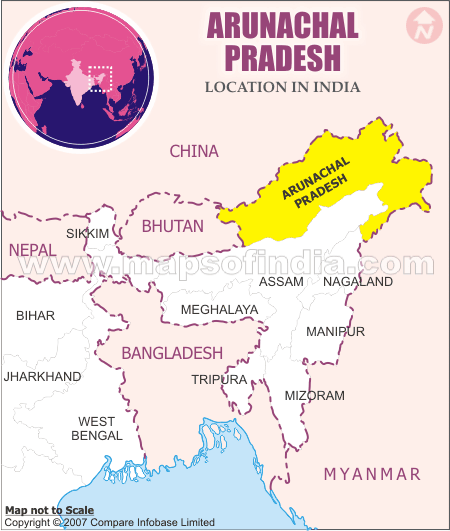
I've dealt with this issue before, and the recent talks between China and India over their borders are turning out to be a joke. Apparently, India has made a grand 'concession' that Tibet is really a part of China, which settles everything. Except that China defines "Tibet" quite differently than India does. A part of (what everyone else recognises as) India is obstinately referred to as "South Tibet".

From Eurasia Review:
February 10, 2012
By Bhaskar Roy
There have been projections among some Indian experts and think tanks that a limited Chinese attack along the unresolved Sino-Indian border may be imminent. This view cannot be totally faulted. They are based on China’s aggressive official and semi-official postures and warning to India, especially on the sovereignty of Tawang, an important Buddhist pilgrim town in India’s north-east state of Arunachal Pradesh.
China claims officially the whole of Arunachal Pradesh as its territory. The official Chinese media, have started referring to Arunachal Pradesh as South Tibet. This is a very important shift in China’s nomenclature of Arunachal Pradesh. This is an effort to now make this Indian state a historical part of Tibet which China militarily occupied in 1950. With India among other countries in the world having acknowledged the original Tibet as a sovereign part of China, extension of Tibet to Arunachal Pradesh may give China an opening into its sovereignty claim on Arunachal Pradesh. Beijing believes it as another instrument to pressure India.


It is now common knowledge that China continues to support insurgent and separatist groups in north-east India.  If Tawang went to China it could garrison its troops there, ignite a major turbulence in north-east India, and roll down from Tawang to engage or cut off the Siliguri chicken-neck, preventing or slowing down Indian military movement. A success of this strategy would be disastrous for India. One can, therefore, understand China’s strong objection and criticism against India’s enhanced force deployment in north-east India. 

What is particularly galling for Indian observers is the fact that China is quietly building its military deployment in Tibet or Tibet Autonomous Region (TAR) that does not appear normal. The Chinese military has constructed or upgraded five airfields in close proximity of the border from the western sector to the eastern sector. There are indications that round the year air deployment is taking place or has already taken place. In the height of winter in January this year, People’s Liberation Army Air Force (PLAF) conducted live fire exercises in TAR.
The railway net work in Tibet may be projected by the Chinese as for development purposes, but its military and strategic emphasis are obvious. At least one full train load of transfer of arms and ammunitions from Golmud to Lhasa has already been conducted. The next step is bring one line to Xigaze (Shigatse) near the eastern sector border, and another to the Nepal border and then on to Kathmandu.
The road infrastructure along the border on the Tibetan side is being continually upgraded, and high altitude military exercises have also been conducted. In fact, two-dimensional military preparations in TAR can be said to be in an advanced stage.
And the Chinese public is being indoctrinated with the case for war with India:
As is well known, the Chinese Communist Party and the government have kept their people starved of information on the happenings in the world. The people have been fed by the state and party controlled media, tailored to project official views and thinking. China’s 500 million netizens’ views on different countries are shaped by official media. A study made by Simon Shen, Associate Professor in the department of social sciences, Hong Kong Institute of Education (published, China Quarterly, Sept. 2001) reveals interesting insights into the minds of these netizens. One thing that emerged from Simon Shen’s three-year research was that 90 percent were hostile to India. On territorial issues, the result was “why should China negotiate with India when it is superior and can hold off India?” India is also seen as servile to the west, and also as imperialist. Over all, the views are anti-India and based very closely if not exactly to the Chinese official propaganda.
This deliberately created mind set by the Chinese authorities can be a double edged sword. While it creates support for the party and the government, at times this can also pressure the authorities to do what they may not want to do. The Sino-India border issue is one of the questions discussed by the Chinese netizens who prefer a military strike in “South Tibet”’ Arunachal Pradesh, to teach India a lesson. These views are not of the 1950s or 1960s, they are contemporary and relevant.
But we have established agreements between the two countries about the border, and China has to honour those agreements, right? Nope:
An India-China conflict can manly be visualized along the borders. This issue is just not moving forward, and China does not want to under the current bilateral agreements. The issue is that China signed an agreement at the Prime Ministerial level in 2005 that there will be no exchange of settled population areas. Since then, they have reneged on this. The recent (Jan 16-17) Senior Representative (SR) level talks on the border and other issues not only saw little progress but rather froze such meetings for some time to come. Hence, one can safely believe that the boundary talks have gone to the mode of ‘time buying’.
So Chinese citizens are ready to go to war with India, China is building the infrastructure needed to go to war in that area, and China claims an entire province as part of India.


Also, from The Daily Mail:
India has increased its troop strength in the region and has taken several measures to improve infrastructure, including border roads.
Beijing has never acknowledged the McMohan Line separating Arunachal from Tibet as the official boundary with India. New Delhi has rejected China's claims over the state.
Sounds like it's all "settled", doesn't it?


Ras: Santorum drops, Romney collapses

Rasmussen's daily tracking polls are generally worthless, and more of an indication of Scott Rasmussen's shifting biases and the uncertain Republican base than an accurate reflection of the electoral race. So, for entertainment purposes, I present the tracking poll for 2/10/12:

In a potential Election 2012 matchup, the president attracts 50% of the vote and former Massachusetts Governor Mitt Romney 40%. This is the largest lead the president has enjoyed against Romney in regular polling going back more than a year. It’s also the first time that the president has reached the 50% level of support against Romney.
Rick Santorum now trails the president by four percentage points, 46% to 42%. Rasmussen Reports will now be tracking the Obama-Santorum race on a daily basis.
Santorum, who just days ago led the President by one point in Rasmussen's polling,  now trails by four.
Romney now trails Obama by ten nationally, which would be astounding if it were supported by any other polling firm.

As I've said before, Rasmussen's sampling (and his "likely voter" screen) is heavily skewed toward Republicans. What these numbers show is what's happening in the Republican base, not in the broader electorate, because it's based on Rasmussen's belief that Democrats won't vote unless they are really unhappy with Obama. Bearing that in mind, we can see that Romney is losing the mantle of "most electable" among the base and Santorum is becoming the new favourite. Naturally, as the new favourite, he must be polling better than Romney. If not, then the Republican base would not be the dominant political force that Rasmussen believes it to be, and they definitely would not be wise and politically savvy geniuses that he "knows" they are.

Also in Rasmussen World, Obama has cracked the 50% approval barrier that is so important to people that think the nation would vote for any idiot over a President they disliked. These people are generally known as right-wing pundits and the fools who take their pronouncements as gospel.

51% now at least somewhat approve of Obama job performance, and 49% disapprove. 37% "strongly disapprove", and that number is dropping down into the range of Republican Party identification.

In Fox News polling (1110 RV including cell), Obama has a job approval of 48%, 45% disapprove, 7% undecided. While that's below the putatively magical 50% mark, it puts Obama above water into positive territory.
Obama leads Romney 47/42.
Obama leads Santorum 50/38.
Obama leads Paul 48/38.
Obama also defeats the hypothetical "white knight" candidate Jeb Bush 50/36. So much for that idea.

Another interesting bit of information comes in the question of how enthusiastic would the respondent be if a particular candidate won.
  • In the "extremely enthusiastic" category, all of the Republican candidates score in the single digits with Romney leading at 9%. Obama scores 20% in this same category. 
  • In the category of "Pleased" if that person won, Romney and Santorum both get 19%. This is only slightly worse than Obama's 21% pleased.
  • In the category of "Scared" if that person won, Gingrich is the clear leader at 33%. Romney as President scares 20%, and Santorum 22%. Obama in a second term scares 27%. This kind of contradicts the wingnut narrative of a scary Obama losing to an imperfect, but not-scary, Republican candidate. Apparently, a 7% difference (at best) between the two options is enough to base an electoral strategy on.
So, if Obama wins we have 41% happy / 27% scared. If the Republican wins, we have 28% happy / 20% scared. That's the big divide in popular opinion that the Right hopes to capitalise on.
That 27% that is scared of Obama just happens to be identical to the "crazification factor" in the American electorate. Even during Bush's darkest hours, you could always find at least 27% of the electorate supporting him. And we are somehow supposed to let those people become the arbiters of an acceptable President.

Let's not forget the Republican primary race. 41% of likely Republican primary voters nationally think that "one or more of the Republican candidates" should drop out, and Ron Paul is the 'favourite' to be that person at 43%. Note to Ron Paul fans with poor reading skills: this means that a considerable number of Republican primary voters want Paul to drop out, not that they prefer him.

So Fox News polling isn't seeing Rasmussen's remarkable 10-point lead for Obama over Romney, nor are they seeing a close race between Obama and Santorum. Weird. It's almost as if Rasmussen is some kind of outlier pollster that nobody really takes seriously.

Sunday, February 05, 2012

The PAC ads begin

This weekend, I saw my first Republican Super PAC ads on broadcast television. It was a pro-Romney ad that said Obama didn't create a single job as a community organiser, or a professor, or a senator. Romney is the guy who knows how to create jobs. He apparently just chooses not to.

My opinion has always been that the first side to employ campaign ads takes a huge psychological hit just by virtue of people hating campaign ads to begin with.

People get to be very good at tuning out campaign ads, so there is definitely a point of diminishing returns. With the use of TIVO and the highly-convenient "mute" button combined with the judicious use of the "channel" button, one can avoid them effectively. There is only a small window of opportunity before the reflexive defences kick in. Right now, the Democrats seem to be winning the narrative, and the polling supports that. We should be able to tell relatively soon how effective this advertising is based on polling numbers over the course of few weeks in markets where it's been employed. If there isn't significant movement, it would seem to me that advertising in general won't be very effective in the coming months. The Republicans are heavily relying on unlimited Super PAC donations allowing them to saturate the airwaves and coerce voters into voting for Romney by sheer force of will.

I think that the majority of the people have already made up their minds, and those that remain see it more as a personality contest. On the personality front, Obama wins over Romney. They can't make Obama scary. It was already tried, and nobody bought it before. At least, not enough people to make difference. So they have to make Romney the guy that you really like. Good luck with that, 1%.

Rasmussen says Santorum leads...really

Rasmussen, continuing to be irrelevant, is posting a tracking poll that shows Rick Santorum would defeat Obama in the national general election.

In a potential Election 2012 matchup, President Obama attracts 47% of the vote and former Massachusetts Governor Mitt Romney earns 43%. These matchup results are updated daily at 9:30 a.m. Eastern.
Matchups for other Republican contenders are updated weekly on a rotating basis. Former Pennsylvania Senator Rick Santorum is at 45% while President Obama earns 44%. This is the first time Santorum has ever led the president in any poll.
Now, PPP has shown Santorum to be the Republican candidate that voters like the most in MN and OH, but that doesn't translate to voter support in those States in match-ups. And Santorum's favourables are the best of a dismal group, but they are still awful. PPP set his favourables in OH at a negative 35/48, while the supposedly "hated" Obama is at 48/48.

Rasmussen can publish results like this because it's virtually impossible for Santorum to win the nomination. While he technically won IA, that is a non-binding caucus. The IA Republican Party will decide who gets the delegates, not the voters. Santorum has a tiny two-point lead in the most recent polling for the MN Republican caucus, but that race is also non-binding. In 2008, Romney won 41% of the caucus vote in MN, with McCain at 22%. That didn't matter, because the the State Party gave all of the delegates to McCain and counted all of the Ron Paul delegates' votes as abstentions. In these non-binding caucuses, the delegates go to the candidate that the Party elders believe has the best chance of winning, not the candidate that the rank-and-file prefer. And in the NV caucus, Santorum came in fourth out of four.

Rasmussen's one-point lead for Santorum is a joke, because that's well within the margin of error. At one point, Rasmussen also had Bachmann leading Obama by two points - and we all know how that worked out.

While Rasmussen has been polling the Republican caucuses, they have yet to do any of the State polling that PPP has done multiple times in a large number of States. Rasmussen, it might seem, doesn't want to establish a baseline that might create contradictions as we approach the election. Instead, they do these "tracking polls" that shift constantly, allowing those on the Right and in the media to have supporting "evidence" for any narrative they might choose. Any candidate's partisans can find a Rasmussen tracking poll that shows their man is the one to beat Obama.

By sitting out the State polling, Rasmussen deprives wingnuts of the delusional ammunition they need to counter PPP's massive pile of data. Instead, conservatives can only point to an alleged Democratic bias in PPP's numbers and reject it out of hand.

It's really hard for Rasmussen to claim that "it's too early" to poll the States, when Rasmussen has been using a "likely voter" screen for more than two years already in their polling. Apparently, it's too early to attempt to find out who leads in which State, but it's long overdue to "know" who will vote in those elections. It's like a weather forecaster saying that they can't tell you what the temperature will be on a certain day eight months from now, but they can be very sure that it will rain.

I'm always suspicious of Rasmussen and his motives. This is the pollster who single-handedly created the myth of the "PUMA" out of whole cloth from his polling, and who pushed the narrative for months until silently abandoning it as we moved into his self-imposed "40-day window" for accuracy. Yes, it's another one of Rasmussen's convenient "things changed" moments.

Rasmussen wants to be taken seriously as a pollster far outside of his "40-day window", but in every election he basically tells us to ignore everything he said outside of that window once we are in it.

By showing Obama ahead on many of these tracking polls, Rasmussen can hedge his bets and point to results later that either support an Obama lead or support a Republican lead. And we can be sure that there will be some minor event within 40 days of the election that Rasmussen designates as his "things changed" moment, and all of his previous polling will be invalidated by this "new development".

Saturday, February 04, 2012

PPP 1/26 national poll

The latest PPP national survey for DKos/SEIU is out. Let's look at the numbers for the 1/26 poll:

  • Voter Enthusiasm - Democrats regain the lead on the enthusiasm gap. 58% of Democrats are "very excited" about "voting in the 2012 elections", while 54% of Republicans are. The national average is now up to 52% "very excited" (VE), which is the number for any demographic to beat, with a lowering to 77% for being at least "somewhat excited" (SE). Voters aged 65+ saw a noticeable increase from 50 to 56 VE, and a less-impressive rise from 79 to 82% SE. The West increased from 42 to 47% VE, but that's still below average. The South rose incrementally to 57% VE, but dropped to 77% SE. This is kind of good news to see the most enthusiastic Republican voters located in states that Obama doesn't need to win. Women are up to 50% VE (still slightly below average) and 78% SE (average). Voters aged 18-29 dropped to their lowest ever 63% SE, but maintain a 51% VE level.
  • Generic Presidential Ballot - Among all voters, Obama pretty much breaks even at 47/46 (O +1). This is exactly what he had at in the last (1/12) poll. Interestingly, Obama prevails 46/42 against Romney in a match-up, which means that Romney is polling 4 points worse than a generic Republican. Independents break 39/44 for the Republicans on the generic, but 35/43 In favour of Obama in the match-up with Romney. Voters aged 18-29 go for Obama by 57/29 in the generic (55/24 in the match-up), which is five-point drop for the generic Republican since the last poll. Voters aged 65+ moved more Republican to an even break of 49/48 (O +1), though Obama carries the demographic by six points in a match-up with Romney. The Midwest saw slight movement toward Obama to an even break 47/46 (O +1), up four for Obama and down 3 for the generic Republican from the last poll.
  • Party Favourables - The Democratic Party dropped four points with white voters from the 1/12 poll, and up four by an equal amount for the Republican Party. Whites break 39/49 in favour of Romney is a match-up, which is quite terrible for the strongest single element of the Republican base. With Independents, the Democratic party breaks 30/53, which sounds bad until you see that the Republican Party breaks 22/59 with them. It's basically an even break for the Democratic Party with the 18-29 demographic (41/43), but a tragedy for the same group with the Republican Party at 29/59. With those aged 65+, The Democratic Party breaks even at 46/46, with the Republican Party showing a negative 35/54. Obama leads by six in a Romney match-up with the 65+ demographic. This indicates that Obama is more popular than the Democratic Party with registered voters aged 65+, and that about 11% of 65+ voters will vote Republican even though they don't like the Party. Which side would get an enthusiasm advantage?
In the Obama/Romney match-up, Obama leads by 4 (46/42) with all registered voters. He also wins women voters by an 11-point margin, and moderates a 25-point margin. Hispanic voters go Obama's way by nearly 30 points, and he also wins 81% of African-Americans. Most notable, the South breaks even at 42/42 for each, with 16% undecided. Obama carries the Midwest by eight points (47/39). Romney draws 79% of self-identified Tea Party voters' vote, and loses to Obama by 23 points with those not in the Tea Party. For all of the "socialist" rhetoric, Romney wins those making $100k/yr by only nine points (40/49) against Obama, with 11% undecided. Obama wins the Northeast by 19 points, and breaks even in the South (as previously mentioned).

Gingrich does poorly against Obama in a match-up, to say the least. Obama wins 49/40 among all voters, and carries women by 18 points. Gingrich wins the exact same 79% of Tea Party voters, but loses by an even larger margin outside of that group than Romney did. Hispanics go more than 2-to-1 for Obama against Gingrich, and Gingrich barely even carries the white vote at 42/46. Obama wins every age demographic against Gingrich - except for the 45-65 group, where he merely breaks even at 45/45 each. Gingrich loses those 18-29 by nearly 40 points.

In other PPP polling, Obama breaks even with Romney in MO (45/45, 9% undecided). The Obama campaign isn't counting on winning MO, but it's a must-win state for the Republicans, who need those 10 electoral votes (EV). As in 2008, the Republican path to 270 EV is fraught with many toss-ups and they must win virtually all of them. Obama only needs to win 1 out of 4 toss-ups in key States to win.

One of those four States is OH, and another PPP poll shows Obama leading there by 7 points against Romney. With 9% undecided, this could be a close race, but it's one that Republicans absolutely have to win to deprive Obama of those 18 EV. McCain lost OH by 5 points in the last election, and Romney is doing slightly worse than that right now.

Tuesday, January 31, 2012

China stonewalling Bhutan on border talks

This has been a kind of one-sided negotiation. Now the Chinese are building permanent structures on Bhutanese territory, but it's just for soldiers, so don't worry.
From Kuensel Online:

Many talks, little progress

Opposition leader suggests need for the government to change its strategy
Bhutan-China Border An issue dating more than 50 years, which, despite 19 rounds of talks, yielded little in return.

This was the feeling among some Parliament members, following foreign minister in-charge Khandu Wangchuk’s update to the house on the issue of Bhutan-China border.
Lyonpo Khandu Wangchuk informed the members that, with regards to the boundary to the south, the government was able to not just discuss in great detail the boundary issues with the neighbour to the south, but they had it settled. He said, however, the same could not be said about the progress vis-a-vis the boundary discussions with the neighbour to the north.
He said the boundary talks with the Chinese government began since 1984, and the country was still pushing towards reaching a decision.

“It’s been 28 years since serious discussions began,” he said. “We’ve had about 19 discussions so far, the last being held in the beginning of 2010 at Thimphu.”
Lyonpo Khandu Wangchuk was responding to the question the Haa parliamentarian Ugyen Tenzin raised, on how the government was progressing in the border discussion with China.
Ugyen Tenzin said the earlier temporary tents Chinese border security pitched during winters, which they bundled up in summers, is being replaced with permanent houses being built along the borders.
“This is a major cause of concern for the people of not just Haa but of the nation,” he said, adding the other issue was of the pastureland at Bjagana being taken into their boundary.
Lyonpo Khandu Wangchuk said the government was just as deeply concerned, and was constantly investigating the northern boundary issue.
Having learnt about the permanent houses being built along the borders, he informed the members that, on October 11,  2011, the Bhutanese government wrote a letter to the Chinese ambassador at Delhi about it and the subsequent concerns it generated in the Bhutanese government.
“In the letter we said the action was in violation of the Guiding Principles agreed on between the two governments in 1998,” he said, adding that an agreement on The Maintenance of Peace and Tranquillity in the Bhutan-China Border Areas was also signed in 1998.
Within 11 days, on October 12, 2011, he said the Chinese government replied, saying they had conducted an investigation into the issue.
“They said,” Lyonpo informed the members, “the permanent houses were built for the border security personnel, so they would be saved the trouble of having to  pitch camps and pack them every year.”
One crucial aspect contained in the letter, he said, was that the Chinese government committed to respect and work in accordance with the agreements drawn between the two nations.
On November 15 and 16 last year the expert survey team from the two nations met to resolve differences over border land of Doklam, Charithang, Sinchulumpa and Dramana.
Despite several discussions, he said they could not reach an agreement, following which the two sides decided to continue the discussion in 2012 at Bangkok, Thailand.
Wangduephodrang Parliament representative Passang Thrinlee said the minister’s update on the Bhutan-China border contained both elements of concern and comfort.

“We hope the Chinese government will consider the plight of a small nation in relation to its boundary,” he said. “We pray they help speed up resolving the boundary issues.”
Opposition leader Tshering Tobgay said although the government had done a fair bit on its part to resolve the border dispute with China, it was time they considered changing the strategy to negotiate.
That the government has 19 rounds of peaceful discussions, drew up guiding principles, while the dialogues dragged on, and people of the two nations continuing to maintain the peace on either sides, he said, were comforting then.
“Today, that is not enough,” he said. “My earnest request to the government is to think up an alternative strategy.”
Lyonpo Khandu Wangchuk welcomed any alternative strategy  members of the Parliament might have in mind, and said the agreements that existed between the two nations, at the moment, served the purpose when the issue remained unresolved.
“There were issues of roads being built along the border between the two nations in the past,” he said, adding that, when the government reminded them it was in breach of the existing agreement between the two nations, they stopped immediately. “They even settled any misunderstandings between peoples of the two nations.”
By Samten Wangchuk

Monday, January 30, 2012

More good news from Rasmussen

Rasmussen doesn't really allow links to his survey results. The link just goes to a page where the old polling results are replaced by more current data, so I can't link to the current Generic Congressional Ballot (GCB) results. You'll have to trust me, or go to Pollster.

But here is the text that I am allowed to see, since I am a non-subscriber:

Monday, January 30, 2012
For the first time in roughly two-and-a-half years, Democrats lead Republicans on the Generic Congressional Ballot, this time for the week ending Sunday, Jan. 29.
A new Rasmussen Reports national telephone survey finds that 41% of Likely U.S. Voters would vote for the Democrat in their district’s congressional race if the election were held today, while 40% would choose the Republican instead.
Date   Dem   GOP
01-29-12   41%   40%
01-22-12   39%   42%
01-15-12   38%   44%
01-08-12   38%   44%
12-30-11   38%   43%
12-22-11   40%   43%
12-18-11   40%   43%
12-11-11   39%   42%
12-04-11   38%   43%
Notice that, since December, Rasmussen has showed at least a three-point lead for Republicans on the GCB. There was a tie in early November, but otherwise his surveys have showed Republicans favoured to win House races. The freshman Republicans who entered the House in 2010 by riding the Tea Party are not popular.

Also, Gallup is showing the Obama / Romney match-up to be a tie.
1/27-28/12; 907 registered voters, 4% margin of error

National
2012 President
48% Obama (D), 48% Romney (R)
53% Obama (D), 41% Gingrich (R)
49% Obama (D), 46% Paul (R)
51% Obama (D), 43% Santorum (R)

A tie at this point from Gallup is actually pretty good, because a lot of pollsters are showing Obama with a lead. Voters (outside of the Republican base) aren't liking what they are seeing in the Republican primaries. This has been a bad introduction to Romney for most people. It's still early and a lot can happen, but most of the things that could go wrong are on the Republican side.

The next PPP national (DKos/SEIU) poll should be interesting.

Sunday, January 29, 2012

Minnesota's 8th CD now a "tossup"

Charlie Cook changed the status of MN-8 from "Lean Republican" to "Tossup" in his latest ratings.

This means trouble for freshman Tea Party Rep. Chip Cravaack. Already in a D+3 district, and only winning election by 1% (48/47) - 4400 votes, he was not a favourite for re-election. He's accomplished nothing for his district, and spent most of his time in NH when not in DC.

Given the latest polling by PPP in MN that shows strong "buyer's remorse" over electing Republicans to the State Legislature, I don't see a strong "incumbent advantage" for Cravaack. His strong backing of Bachmann hasn't won over Independents, as the same polling shows that Bachmann is very unpopular outside of her narrow 16% "very conservative" base and gerrymandered district.

His big issue, aside from rabid anti-choice positions, was the Clean Water Act, and most particularly H.R 5088. This was the legislation introduced by Oberstar that Cravaack railed against. Cravaack can claim a small victory by tying it up in committee, but that was merely a holding action. That fight is over, and he can't claim to have done anything for the economy by voting the Party line on legislation that had no chance of passing the Senate. His votes were completely rubber-stamp in line with instructions from the Party, so it's hard to say that he's representing his constituents. A vote for Cravaack is essentially a vote for Boehner, because that's who tells Cravaack how to vote.

Meanwhile, Cook rates Democrat Tim Walz's seat as "Likely Democratic", though it's R+1. He held on to his seat against Randy Demmer, in spite of high wingnut hopes, and won by 5% in a great Republican year. Now Allen Quist and Mike Parry will battle over the chance to take on Walz in 2012. It will probably be Parry, who is the typical angry, crazy Tea Party-inspired kind of guy that the electorate is tired of. Quist is a really boring Religious Right bozo who embraced the Tea Party late in the game, and who is notable for failing to win his bid for Governor many years ago. If Quist wins, he'd be one of the few cases of the MN GOP recycling a loser, and he's probably only being considered because the MN Republican Party has been taken completely over by the evangelicals.

There hasn't been a dramatic shift to the Left in Minnesota, as much as there's been a massive and broad-based shudder of revulsion over what the Republicans have turned themselves into. And nothing right now is looking like they are backing away from their image of enraged, hateful, over-the-top, completely interchangeable nuts who all say the exact same thing.

Saturday, January 28, 2012

New MN polling is bad news for the wingnuts

New polling is out by PPP on Minnesota. They last polled the State in June.
Quick summary: Gov. Dayton is popular, Democrats lead by 9 on the GLB, and the SSM Amendment is close.
Gingrich leads the (non-binding) Republican caucus, and loses to Obama by 15. Romney loses to Obama by 10 points. Bachmann and Pawlenty are not popular at all, with Bachmann seeing particularly bad statewide numbers. Klobuchar is a lock for re-election.

Just how bad are Bachmann's numbers? PPP's Tom Jensen reports:

Voters hold an unfavorable opinion of Michele Bachmann by a 34-57 margin, including a 29-59 rating among Independents. 57% of Minnesota voters also say Bachmann should not run for reelection to the House of Representatives while just 37% think she should. 59% of Independents and even 20% of Republicans say Bachmann should not run for reelection.

 So it's bad, then.
Bachmann wins strong approval (85%) from those voters who consider themselves "very conservative", but they are only 16% of the electorate. Those who say they are "somewhat conservative" favour her with a less-impressive 56% support. Pretty weak for your "base". This "somewhat conservative" category holds 22% of the electorate. That's a total of 38% of the electorate with any kind of significant appeal for her. Moderates break highly unfavourably against her by more than 4-to-1. In other words, she has no appeal outside of that narrow conservative demographic.
This doesn't say anything about her chances of holding on to her House seat. The re-districting is still up in the air. Currently, Bachmann is living in the potential new district that includes St.Paul, and she has no hope of winning there. If the re-districting gives her her old district back, then her chances look good. But that district would be an isolated pocket of concentrated wingnuts that Bachmann could have trouble appealing to as time goes by.

One thing is sure: she has no hope outside of that district or in the State as a whole. Moderates, by more than 3-to-1, say she should not run for re-election. 22% of Minnesotans who voted for McCain in 2008 also do not want her to run again. Even worse, a majority of all age demographics say the same thing. And 59% of Independent voters don't want her to run for the House a fourth time, either.
Basically, the State of Minnesota is really tired of her.

The days when wingnuts could pretend that Bachmann is some kind of insurgent truth-teller who would "blow the minds" of the "urban liberals" are GONE. She is a punchline, not an evangelist for the conservative cause in Minnesota. She's done nothing for her district. And, from the St. Cloud Times:

Bachmann missed almost 59 percent of House roll-call votes in the third quarter of 2011, and more than 91 percent of votes in the fourth quarter.

At some point, the MN GOP will realise that she is not the best face for their cause, that she is a liability, and a very expensive candidate that sucks up donations that could be better spent elsewhere. Right now, though, the MN GOP is in the thrall of the evangelical Religious Right, and Bachmann is their poster child.

For the DFL, it is probably wiser not to contest her strongly, and focus instead on regaining the 8th CD from Cravaak, and defending Walz from a very "insider" challenge. Let Bachmann be the face of the MN GOP, and remind MN voters constantly of what the alternative to the DFL is.

As far as Pawlenty:

Q9 Would you support Tim Pawlenty for statewide
office in the future, or not?
Would support Pawlenty for statewide office .. 39%
Would not........................................................ 51%
Not sure .......................................................... 10%
That "would not" figure includes 50% of the 65+ age demographic, 15% of Republicans, 52% of women, 56% of moderates, and 52% of Independents. He only wins about 2/3 of that conservative 38% on this question, which is not strong when looking at your base. Remember, Pawlenty primarily won office by portraying himself as a moderate who down-played his evangelical beliefs. As the Tea Party rose, he transformed himself into a strong 10th Amendment advocate, a vitriolic hater of Obama, and an unquestioning pawn of the Religious Right. Look where it got him. Only 68% of "very conservative" MN voters want him to run for statewide office.

Rasmussen struggling with their narrative

Rasmussen's Presidential approval ratings are slipping away from the wingnut narrative.

In December, Rasmussen was able to regularly scrounge up around 45% "strong disapproval" for Obama. In January, though they are struggling to find 40% "strong disapproval". December began with 43% SD, and steadily moved up to a peak of 49% just before Christmas. That's also when Rasmussen chose to do their match-ups, showing Obama down six(!). This result was a glaring outlier among pollster, but it was their last chance to get some ridiculous numbers out there before moving into 2012 - when "things changed".

And a president who struggled to get 1/5 "strong approval" in December now is moving into 1/4 SA. And only a bare majority of 51% now disapprove of Obama (1/28) in Rasmussen's crazy, skewed, right-wing sampling world.

This entire "strong approval / strong disapproval" thing was implemented by Rasmussen when Obama took office. Previously, this category didn't matter to Rasmussen. But when Obama took over from Bush, it was suddenly very important how intensely people disliked Obama. It's part of his whole "Democrats don't really vote" narrative, which influences his "likely voter" screen. It's weird how, two years before an election, Rasmussen can determine who is "likely" to turn out. Even at eight months out (now), it would be considered too unreliable to employ LV screens by most pollsters. By manipulating this LV screen and his "panel" of hand-picked internet voters, he can pretty much come up with any numbers he wishes to. But he's accurate! Sure, except for 2010, and only when you get within 40 days of an election. Outside of that 40-day window, he's free to publish results that are contrary to everyone else. Once inside the 40-day window, "things change" and the wingnuts are left to despair that their hero pollster has been "taken in by the liberal media".

On 12/28/11 Rasmussen released a poll that I will hold him to: Romney defeats Obama 45/39.  +6R

On 1/4/12, Rasmussen says it's a tie: 42/42.

On 1/10/12, Rasmussen gives Obama a 3-point lead: 41/44.  +3D

Now, a 3-point lead is simply Rasmussen hedging his bets. That's within the margin of error, so he can easily shift it back to appease wingnuts. But the slow erosion of "strong disapproval", and the slow growth of the "strong approval" numbers show that Rasmussen is unwilling to go too far out on a limb for the Republicans right now. And that should make Republicans nervous.

After more than four years (including the 2008 election campaign) of constantly painting Obama as dangerous / inept / too powerful / too weak, only a bare majority actually disapproves of Obama in Rasmussen's sampling. It still hasn't dawned on the wingnuts that Obama isn't hated and that their "magic words" (socialist, Muslim, worst President, etc.) aren't working anymore. But the most right-wing national pollster in America is figuring that out, because his reputation was already damaged in 2010 and he needs to be taken seriously. Otherwise, his speaker's fees dry up.

UPDATE 1/30/12:
Rasmussen now shows Obama with a bare majority favourable: 51% approve, 47 disapprove.
The 37% "strong disapproval" is more in line with June '11.